
For a quick fix on a tiny patch of mould, you can try a mix of equal parts white vinegar and water. Just spray the spot, give it a good scrub with a brush, and then get it completely dry with fans or a dehumidifier to stop it from coming right back. Simple as that. This can work for minor spots, but remember, safety first… and drying is absolutely non-negotiable.
Understanding Why Mould Loves Your Carpet
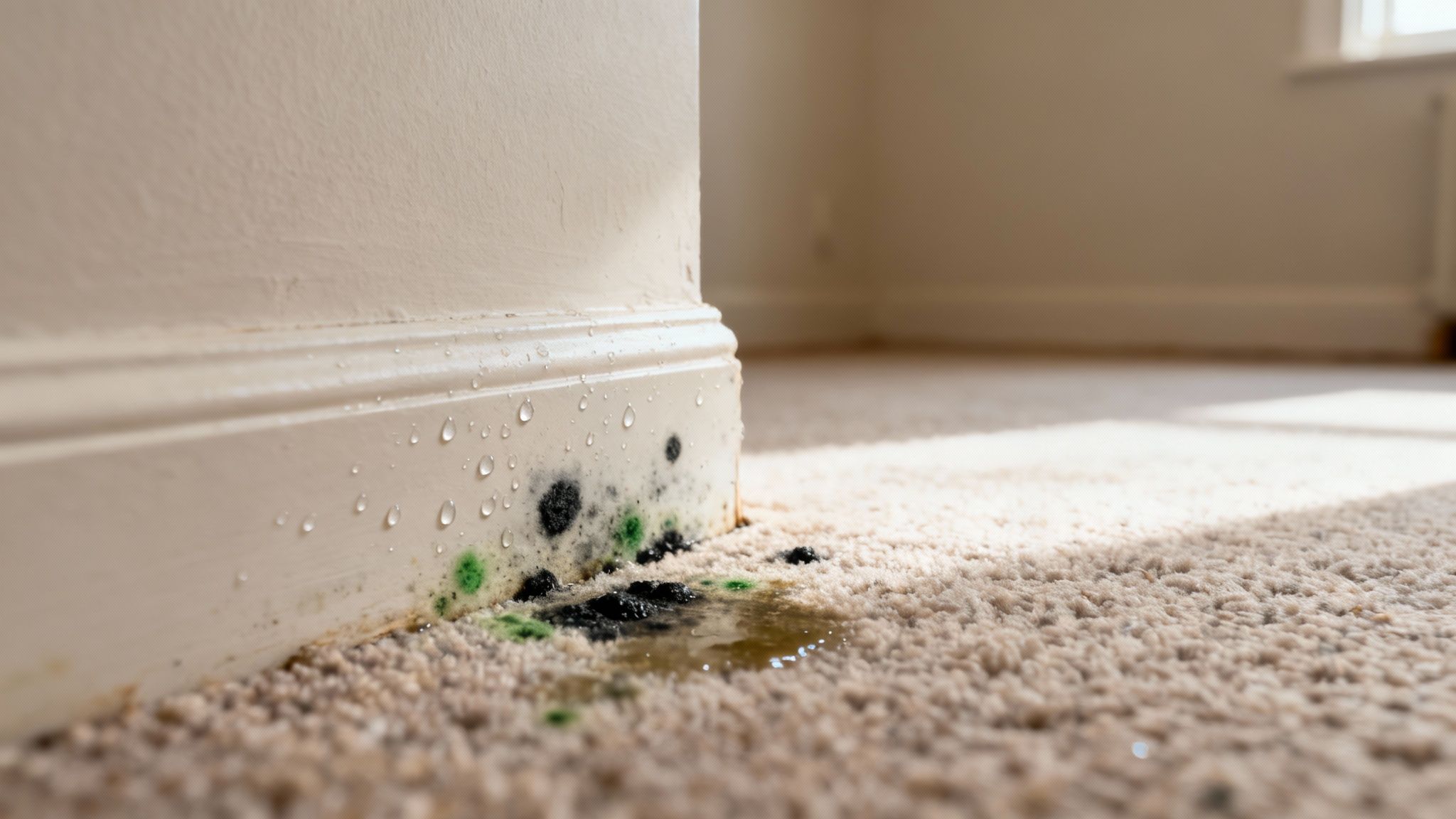
Ever walked into a room and caught a whiff of that musty, earthy smell you just can't track down? Yep. That’s often the first clue that mould has made itself at home in your carpet. And unfortunately for us, it's an unwelcome guest that finds our carpets incredibly inviting.
Think of your carpet as a giant, comfy sponge. It’s soft, absorbent, and brilliant at trapping things. Great for dust. Not so great when moisture gets involved.
The Perfect Storm for Mould Growth
Mould isn't just some random fuzzy patch; it's a type of fungus. A living thing. And like any living thing, it needs a few key ingredients to really get going. Your carpet can accidentally provide all of them in one convenient package.
It all starts with mould spores. These microscopic particles are everywhere. All the time. Just floating in the air. They’re usually harmless, just waiting for the right conditions to settle down and start a family. When they land on a carpet that offers them a bit of food and water… well, they’ve basically hit the jackpot.
So what turns your carpet into the ideal mould hotel?
- Persistent Moisture: This is the big one. The number one culprit, without a doubt. It could be from a big event like a flood, a slow leak from a pipe you haven't noticed, or even just high humidity in the air, which is so common in many parts of Australia.
- A Food Source: Mould isn't fussy. Not at all. It will happily feed on the natural fibres in your carpet (like wool), but it also loves munching on the dust, skin cells, and dirt trapped deep within the pile.
- Poor Airflow: Stagnant air allows moisture to settle and hang around, giving those spores plenty of time to get started. A room with closed windows and poor ventilation is paradise for mould.
Mould is a surprisingly common issue in Australian homes. A recent study found that even with improvements in housing, a significant number of homes still have issues like roof defects or rising damp that can lead to mould. This just shows how important it is to manage moisture and inspect your carpets regularly, especially in older properties. You can read more about these findings on mould in Australian homes.
The scary part? Mould can start growing in as little as 24 to 48 hours after a carpet gets wet. That's why acting fast after a spill is so incredibly important.
Ignoring it isn't just about a bad smell or an ugly stain. Those airborne spores can cause real problems for your family's health, triggering allergies, asthma attacks, and other respiratory issues. Tackling it quickly isn't just about protecting your home, it's about protecting the people living in it.
How to Find and Assess Carpet Mould
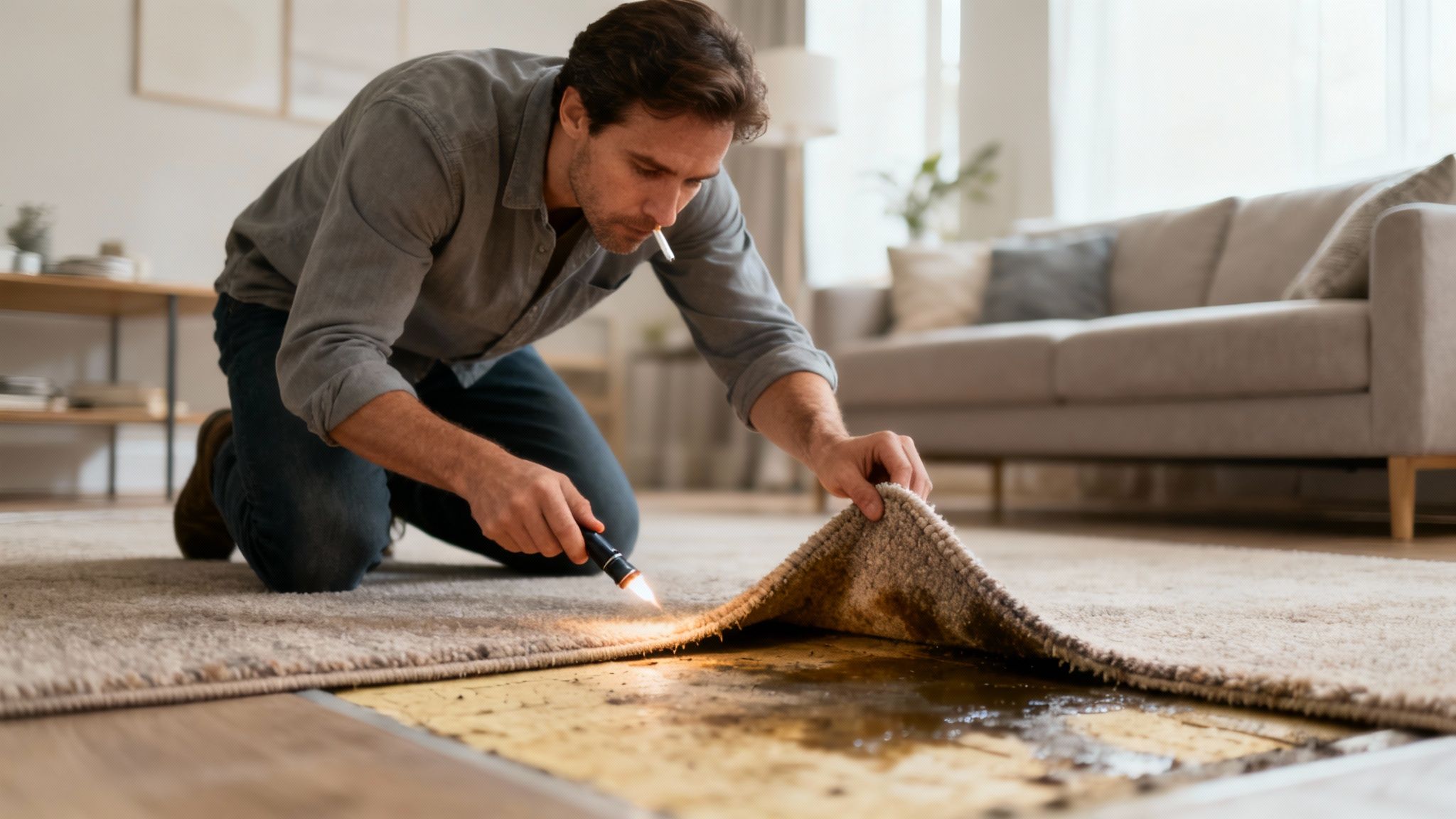
Alright, so you’ve got a sneaking suspicion that mould has moved in. Now it’s time to play detective. Finding and properly assessing the situation is the most important first step, because it tells you exactly what you’re up against.
Don’t just give the carpet a quick glance from the doorway. You’ll need to get down and have a proper look. Sometimes the problem is obvious… a patch of fuzzy black or greenish spots screaming at you from the corner of the room. But often, it's a bit more subtle than that.
Your Visual Inspection Checklist
Start by looking for anything that seems out of place. It’s a bit like searching for clues at a crime scene. And your carpet is the victim here.
Keep an eye out for these tell-tale signs:
- Visible Growth: This is the easiest to spot. Look for fuzzy or slimy patches that can be black, green, white, or even shades of orange and brown.
- Discolouration: Check for persistent stains or patches where the carpet colour looks faded or just… off. This can be a sign of mould eating away at the dyes in the fibres.
- Dampness: Gently press down on the suspected area. If it feels even slightly damp or spongy to the touch, that’s a massive red flag.
Next, you need to trust your nose. Seriously. The 'sniff test' is surprisingly effective. Get close to the carpet and take a gentle sniff. If you get a distinct musty, earthy smell… like a damp forest floor or old, wet socks… that’s the signature scent of mould at work.
Deciding Your Next Move: DIY or Pro?
Now for the big question. Can you handle this yourself, or is it time to call for backup? The answer really comes down to the size and depth of the problem.
Think of it like this: a small surface spill that you catch quickly is like a little campfire. You can probably put it out yourself. But if that fire has spread into the undergrowth, or in this case, the underlay, you’ve got a much bigger problem on your hands that requires professional help.
Here’s a simple guide to help you decide:
- Go the DIY route if: The mouldy patch is small (less than a square metre), seems to be only on the surface, and is from a recent, minor spill that has since dried.
- Call the professionals when: The mould covers a large area, the musty smell is strong and persistent even after cleaning, or you suspect the problem has soaked through to the carpet underlay or the subfloor beneath.
If the carpet has been wet for more than 48 hours, it's almost certain the mould has penetrated deep into the padding. At that point, a surface clean just won't cut it. Calling in the experts is the safest and most effective choice.
Assembling Your DIY Mould Removal Toolkit
Alright, you've done your detective work and you're ready to get stuck in. But before you start scrubbing, let's take a moment. Think of this as your pre-mission briefing. Getting your gear and game plan sorted is half the battle when you're figuring out how to get rid of mould in your carpet.
Honestly, this isn't just about cleaning. It's about doing it safely. Mould spores are microscopic troublemakers that go airborne the second you disturb them. You definitely don't want to be breathing that stuff in.
Safety First. Always.
This part is absolutely non-negotiable. You’re dealing with a fungus that can mess with your health, so protecting yourself has to be the top priority. It might feel like overkill for a small patch, but believe me, it’s always better to be too careful.
Here’s your essential personal protective equipment (PPE):
- A P2 Respirator Mask: Not just any flimsy dust mask. A proper P2 mask is designed to filter out fine particles like mould spores.
- Safety Glasses or Goggles: These will shield your eyes from both cleaning solutions and any airborne spores that get kicked up.
- Durable Gloves: Good quality rubber or nitrile gloves are a must to keep the mould and cleaning agents off your skin.
Once you’re kitted out, you can start gathering the tools for the job. You don't necessarily need the harshest chemicals on the shelf to get results. In fact, some of the most effective solutions are probably already sitting in your pantry.
Building Your Cleaning Kit
The goal here isn't to blast the carpet with aggressive chemicals, which can often do more harm than good to the fibres. Instead, we're focusing on what actually works to kill the mould at its source and get things clean.
Your main cleaning agents will likely be one of the common household items below.
DIY Mould Cleaning Solutions Compared
Here's a quick look at common household items you can use to treat minor carpet mould, highlighting their pros and cons.
| Solution | How It Works | Best For | A Word of Caution |
|---|---|---|---|
| White Vinegar | The acetic acid in vinegar is a natural antifungal that breaks down and kills many common types of mould. | Small to medium patches on most carpet types. | The smell can be strong but will fade as it dries. Never mix with bleach. |
| Baking Soda | A mild abrasive that helps lift mould from fibres. It also absorbs moisture and helps deodorise the area. | Surface-level mould and getting rid of that musty smell. | Less effective at killing the mould roots on its own; best used with vinegar. |
| Store-Bought Cleaners | Formulated specifically to kill mould and mildew, often containing fungicides. | Stubborn spots, but requires careful selection. | Always test on a hidden area first to check for colourfastness or fibre damage. Avoid bleach. |
Along with your chosen cleaner, you'll also need a stiff-bristled brush for scrubbing, a spray bottle to apply your solution, and a stack of old towels for blotting the area dry. For a deeper dive into which solution is best for your situation, our guide on choosing a natural mould killer can give you some extra insights.
One final, crucial piece of equipment… your vacuum cleaner. Just grabbing your standard vacuum can actually make the problem worse by sucking up spores from the carpet and blasting them right back out into the air.
This is critical. You need a vacuum cleaner with a HEPA filter. This type of filter is designed to trap microscopic particles, including mould spores, preventing them from being recirculated around your home. It’s an absolutely essential tool for the final clean-up phase.
A Practical Guide to Cleaning Carpet Mould
Alright, this is where the real work begins. Let's walk through this together so you know exactly what to do. Think of it less as a chore and more like a rescue mission for your carpet.
First things first. Containment. Mould spores are like glitter… the moment you disturb them, they get everywhere. To stop that from happening, you need to isolate the room as best you can.
Close the door to the room you're working in. If you have an exhaust fan, turn it on. If not, open a window to the outside, but make sure any windows or doors leading to other parts of the house are shut tight. This creates a controlled zone. It encourages airborne spores to head outside rather than taking a tour of your home.
This simple infographic breaks down the core process into three key stages: Protect, Clean, and Dry.
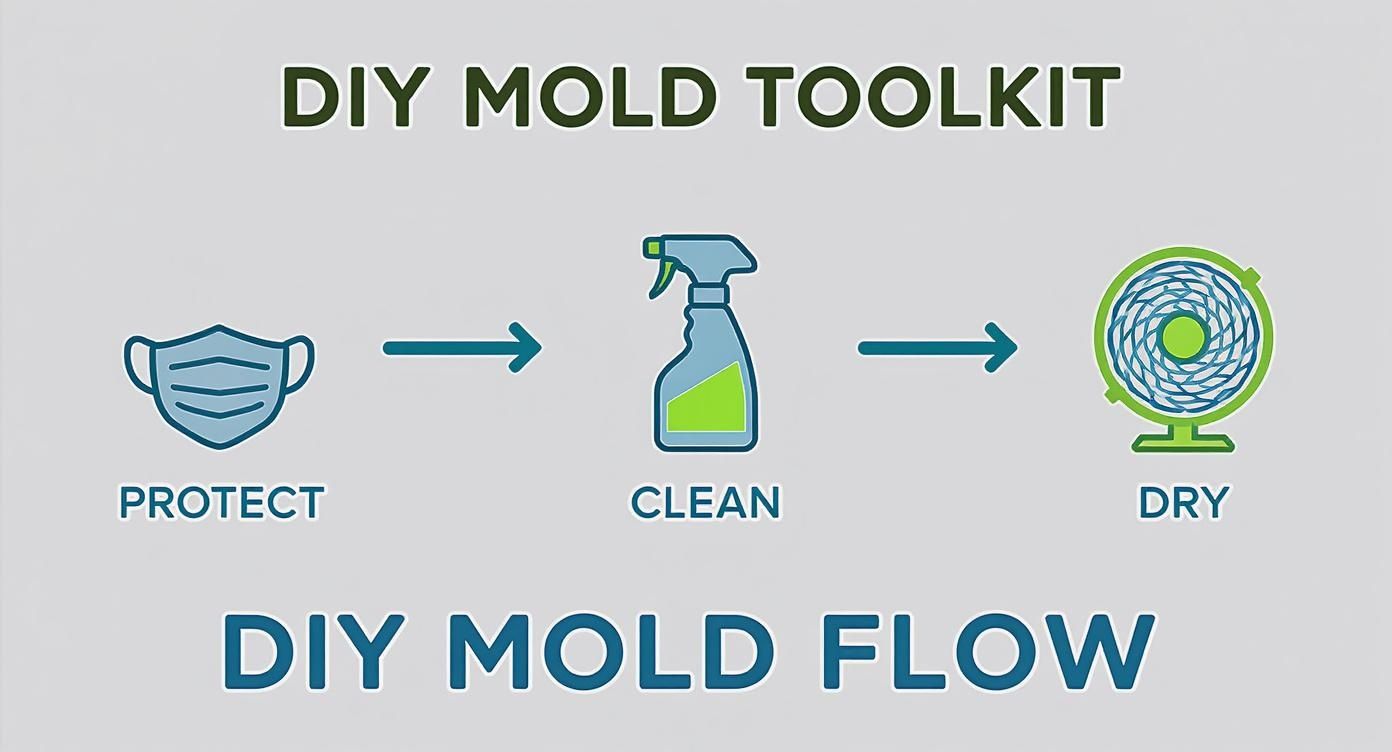
It’s a great reminder that safety and thorough drying are just as important as the cleaning itself.
Applying Your Cleaning Solution
Now for the cleaning. Grab the solution you chose earlier, whether that’s a vinegar mix or a store-bought cleaner, and get it into a spray bottle. Lightly mist the mouldy area. The key word here is mist. Not soak.
One of the biggest mistakes people make is over-saturating the carpet. You're trying to solve a moisture problem, not create a bigger one. A damp carpet is a mouldy carpet’s best friend, and we're trying to end that friendship for good.
Once you’ve applied the solution, let it sit for a good few minutes. This gives it time to work its magic and start breaking down the mould.
Next, take a stiff-bristled brush and gently agitate the area. You’re not trying to scrub the life out of your carpet fibres. Just use gentle, circular motions to loosen the mould from the pile.
After scrubbing, it's time to blot. Grab some clean, dry cloths or paper towels and press down firmly on the area to absorb as much of the moisture and cleaning solution as possible. Keep doing this with fresh cloths until the spot is as dry as you can get it by hand. Whatever you do, blot, don’t rub. Rubbing can damage the carpet fibres and push the mould deeper into the backing.
The All-Important Drying Phase
I can’t stress this enough. Getting your carpet completely, totally, bone-dry is the most critical part of this entire process. Any lingering dampness is just an open invitation for the mould to come right back. And all your hard work will be for nothing.
This is where you bring in the heavy machinery. Well, not exactly heavy, but definitely necessary.
- Fans: Position a few fans to blow directly across the surface of the damp patch. Constant airflow is brilliant for speeding up evaporation.
- Dehumidifiers: If you have one, now is its time to shine. A dehumidifier will pull moisture right out of the air and, by extension, out of your carpet. It's an absolute game-changer for this step.
In Australia, dealing with carpet mould properly is a common challenge, especially after any kind of water damage. For small patches, official advice often mirrors our process with a heavy emphasis on drying. Using a dehumidifier before, during, and after cleaning is a key recommendation to ensure every last bit of moisture is gone. You can find more details in these Australian mould remediation guidelines.
Let the fans and dehumidifier run for at least 24 hours. Maybe even longer if needed. The carpet should feel completely dry to the touch, with no hint of coldness or damp. If you're lucky enough to have a sunny day, you can even pull the carpet up and let it sit outside for a while. Sunshine is a fantastic natural mould killer.
When You Need to Replace Your Carpet
Sometimes, the smartest move is knowing when a fight just can’t be won. We’ve talked about cleaning and treating mould, but there are times when, honestly, the best way to get rid of mould in your carpet for good is to get rid of the carpet itself.
It’s a tough call, I know. But once mould works its way deep into the carpet underlay, you’re dealing with a whole different beast. Think of the underlay as a dense, thick sponge. When mould sets up camp in there, it’s almost impossible to completely kick it out.
Surface cleaning at this point is like putting a small plaster on a major wound. It might look a little better for a while, but the real problem is still festering away, completely out of sight.
Signs It's Time to Say Goodbye
So, how do you know when you’ve crossed the line from a manageable spot to a full-blown replacement job? Your carpet will usually give you some pretty clear clues.
You're probably looking at a replacement if:
- The Musty Smell Lingers: You’ve cleaned the area thoroughly, aired it out, and yet that damp, earthy smell just won’t shift. This is a huge red flag that mould is living deep in the underlay or even the subfloor beneath.
- The Stains are Widespread: If the mould covers a large area… more than a square metre or so… the chances of it having penetrated the underlay are extremely high.
- The Carpet Was Wet for a Long Time: If your carpet was soaked from a flood or a serious leak and wasn't dried out within 48 hours, you can almost guarantee the problem goes far deeper than the surface fibres.
It’s a hard truth, but trying to save a deeply infested carpet is often a losing battle. You’ll spend time and money on cleaning, only for the mould to reappear a few months later because you never actually got to the root of the problem.
Here in Australia, the advice from remediation experts is clear on this. When mould hits the carpet underlay, surface treatments are rarely enough. The focus has to shift to removing the compromised materials and treating the subfloor itself to stop the mould from coming back. This often involves applying a moisture barrier to the floor before any new flooring is laid. For a deeper understanding of this process, you can explore some expert advice from Australian DIY forums.
While it feels like a drastic and expensive step, replacing the carpet is often the safest and most effective solution for a severe mould issue. If the infestation is significant, professional mould remediation services can ensure the entire area, including the subfloor, is properly treated before your new carpet is installed.
Think of it not as a loss, but as a crucial investment in the health of your home and your family.
Your Mould Prevention Playbook
You’ve won the battle against visible mould. Great work. But the war isn't over. Getting rid of the mould you can see is only half the job. The real victory is making sure it never gets a chance to come back.
This is all about turning your home into an environment where mould simply can’t get comfortable. We need to shift from being reactive to proactive. Think of it like a leaky roof. You wouldn't just mop up the puddle on the floor; you’d find the hole and fix it. Same idea here.
Master Your Home's Airflow
One of the simplest yet most effective things you can do is get the air moving. Mould absolutely loves stagnant, humid air. It's like a warm hug for fungus.
You can easily disrupt its plans by:
- Opening Windows: Just 15-20 minutes a day makes a massive difference. Letting fresh air circulate pushes out that damp, stale air mould thrives in.
- Using Exhaust Fans: Always flick on the fan when you're showering or cooking. These are peak times for moisture production, and that fan is your first line of defence, pulling steam out before it settles.
It's the small, consistent habits that make the biggest difference. You don’t need to overhaul your entire home. Just build these simple actions into your daily routine.
Become a Moisture Detective
Next up, get really good at managing moisture levels. Especially in those sneaky, damp-prone corners of your home.
This means being vigilant. First, clean up spills the second they happen. Don't let a small puddle from a dropped glass become a future mould patch. Blot it, dry it, and make sure the area is completely free of moisture.
Get into the habit of regularly checking potential trouble spots, too. A quick look under the kitchen and bathroom sinks, or around window frames after a heavy downpour, can help you catch a small leak before it turns into a disaster.
Your Quick Prevention Checklist
Keeping on top of everything can feel like a lot, so here’s a simple checklist to keep in your back pocket:
- Deploy a Dehumidifier: In naturally damp spots like basements, laundries, or bathrooms with poor ventilation, a dehumidifier is your best mate. It actively pulls moisture from the air, keeping humidity levels where they should be.
- Act Fast on Spills: Keep absorbent cloths handy and tackle any spills on your carpet immediately. That 24-48 hour window is absolutely crucial before mould spores can take hold.
- Regularly Inspect Problem Areas: Once a month, do a quick tour. Check under sinks, behind toilets, and around appliance hoses for any signs of moisture.
By making these simple practices part of your routine, you’re not just cleaning up after mould. You’re building a solid defence against it.
For a more detailed look at tackling mould throughout your home, our comprehensive guide on how to get rid of mould is packed with useful information. This playbook will help you transform your home from a potential mould haven into a place where it simply can’t survive.
Common Questions We Hear About Carpet Mould
We get it. Discovering mould can bring up a lot of questions and a fair bit of worry. You're not alone in wondering about this stuff, so let's tackle some of the most common questions we hear to help clear the air… literally.
Can I Use Bleach to Clean Mould on My Carpet?
Honestly, we really advise against this. It might seem like the strongest, go-to option, but bleach and carpets are just not a good mix. At best, it can easily discolour your carpet. At worst, it can permanently damage the fibres.
More than that, bleach isn't very effective at killing mould on porous surfaces like carpet. It often just cleans what you can see on top, leaving the mould's roots intact deep in the underlay, ready to grow right back. A simple white vinegar solution is generally much safer and more effective for this particular job.
How Quickly Can Mould Grow in a Wet Carpet?
This one surprises a lot of people. In the right conditions… think warmth and humidity… mould can start growing in a damp carpet in as little as 24 to 48 hours. It's incredibly fast.
This tiny window is exactly why acting immediately after a spill, leak, or any kind of water exposure is so critical. You're not just cleaning a mess. You're actively stopping a much bigger mould problem from ever getting started.
A common question we get is whether even a small amount of mould is dangerous. The answer is yes, it can be. Any amount of mould can release spores into the air, which can be a real issue for people with allergies, asthma, or compromised immune systems. It’s always best to treat every patch of mould, no matter the size, with caution and deal with it promptly.
When you're facing a mould problem that feels too big to handle, or you just want the peace of mind that it's gone for good, That Cleaning Crew is here to help. Our professional mould remediation services ensure the job is done safely and thoroughly. Find out more and get your free on-site quote at https://www.thatcleaningcrew.com.au.