A commercial office cleaning contract is just a fancy term for a legally binding agreement. It simply spells out the scope, frequency, and quality standards for all the cleaning services happening in your business. It lines up everything from what gets cleaned and how often to the specific costs, making sure you and the cleaning company are totally on the same page.
Think of it as the official playbook for keeping your workplace looking professional and feeling hygienic.
Why a Cleaning Contract Is Your Best Friend
The word 'contract' can sound a bit heavy, can't it? It often brings to mind pages of dense legal text. But when it comes to keeping your office consistently clean, a contract isn't a burden… it's your best friend.
Imagine you're following a detailed recipe. Instead of ending up with a lumpy, half-baked cake, you get a perfect result every time because all the steps and ingredients are clearly listed. A commercial office cleaning contract does the same thing for your workspace.
Moving Beyond a Handshake Agreement
A simple handshake deal might feel easy and quick at first, but it almost always leads to confusion down the line. What one person considers ‘clean’, another might see as a job half-done. Without a written agreement, you're left guessing. And that’s where things get messy.
This is where a formal contract steps in to provide total clarity. It’s not just about ticking a compliance box; it's about building a solid foundation for a genuine partnership. It protects your business, your staff, and your cleaning provider by making sure everyone knows exactly what's expected from day one. To get a better feel for this, it’s helpful to understand the fundamental principles of business contracts.
A well-written contract is the difference between hoping for a clean office and guaranteeing one. It transforms ambiguity into accountability, ensuring the service you pay for is the service you actually receive.
The Real Benefits of Having It in Writing
So, what does this actually mean for you as a facilities manager or business owner?
Peace of mind. Simple as that.
Knowing that the plan is understood and agreed upon allows you to focus on your real job, not on chasing up missed bins or dusty desks.
A formal contract delivers several key advantages:
- Sets Clear Expectations: It specifies exactly which areas get cleaned, what tasks are performed (like vacuuming, mopping, and sanitising), and how often it all happens. No more grey areas.
- Ensures Consistent Quality: It establishes measurable standards, so you can objectively assess the performance of your cleaning crew. You know what 'good' looks like.
- Provides Legal Protection: It outlines responsibilities, insurance requirements, and what happens if things don't go to plan, protecting both you and the provider.
- Manages Your Budget: It locks in pricing and details how extra services or changes are handled, so you’re never hit with surprise costs.
Ultimately, a good contract is the starting point for a professional relationship. If you're new to this world, it helps to understand what commercial cleaning truly involves, as it's much more specialised than cleaning your house. You can learn more about the specifics of commercial cleaning in our guide.
Decoding the Key Clauses in Your Cleaning Contract
Alright, let's pull apart the actual document. This is where the real details live. Understanding the main clauses in a commercial office cleaning contract is your best tool for getting exactly what you pay for. It can feel like you're reading a different language, but once you know what to look for, it's actually pretty straightforward.
Think of it like a blueprint for a house. Each section describes a different part of the structure, from the foundation to the roof. Get one part wrong, and the whole thing can feel a bit wobbly. We’re going to walk through the most important parts of that blueprint… one by one.
This helpful graphic breaks down a contract's core purpose into three simple ideas.
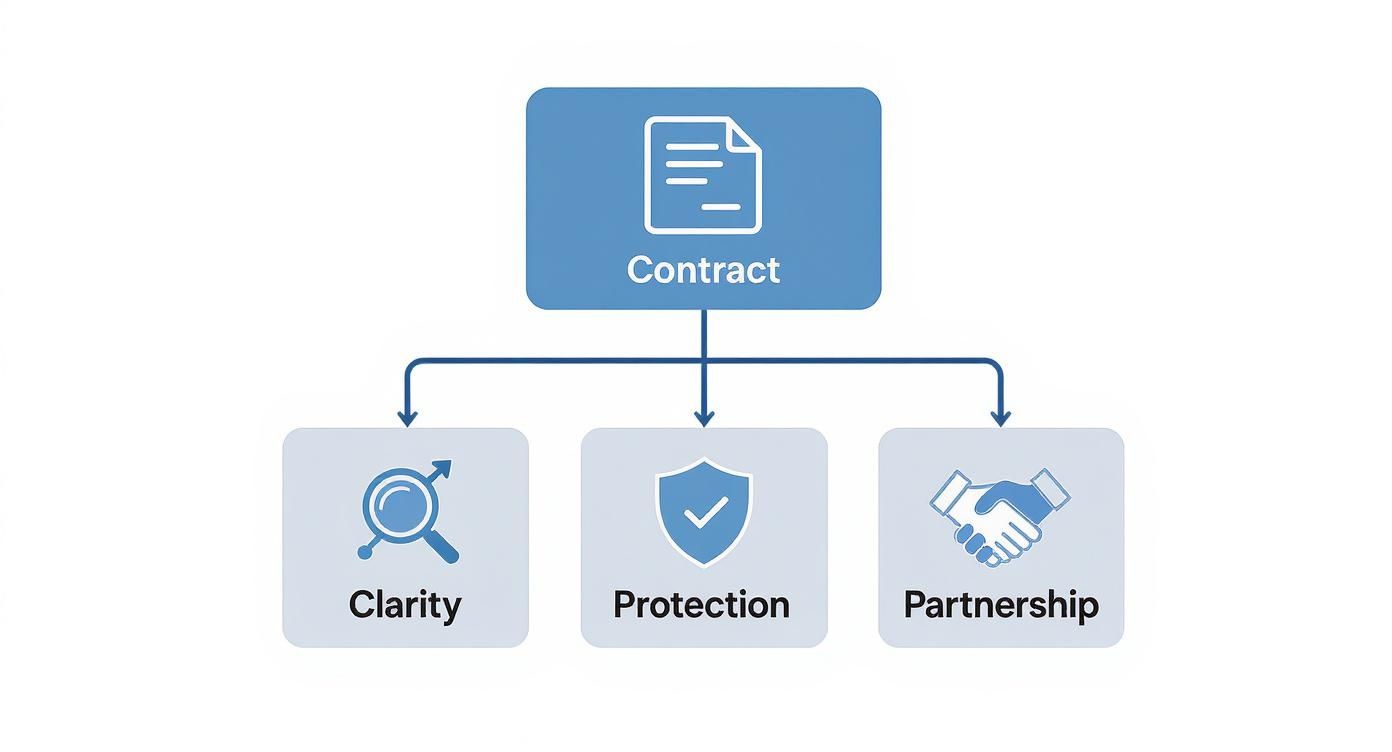
Ultimately, every clause should contribute to clarity, protection, or a stronger partnership between you and your cleaning provider. It’s that simple.
To get started, here's a quick look at the must-have clauses in any decent cleaning agreement.
Essential Clauses in a Cleaning Contract
This table is your quick-reference guide to the non-negotiable clauses you should find in your commercial cleaning agreement and what they actually mean for your business.
| Clause | What It Covers | Why It's Important for You |
|---|---|---|
| Scope of Work | A detailed checklist of all cleaning tasks and the specific areas to be cleaned. | Prevents misunderstandings by creating a clear, shared expectation of what "clean" looks like. |
| Service Frequency | How often the cleaning team will be on-site (e.g., daily, twice-weekly, monthly). | Ensures service levels match your office's real-world needs and budget. |
| SLAs & KPIs | Measurable standards for service quality, like inspection scores or response times. | Turns subjective feelings about cleanliness into objective, measurable proof of performance. |
| Pricing & Variations | The cost structure (fixed fee, hourly) and how extra services are priced and requested. | Provides budget clarity and a process for handling one-off cleaning needs without confusion. |
| Termination | The conditions and notice period required for either party to end the contract. | Gives both you and the provider a clear, fair exit strategy if the partnership doesn't work out. |
| Insurance & Compliance | Proof of public liability insurance, workers' compensation, and adherence to regulations. | Protects your business from liability in case of accidents or damage on your property. |
Understanding these sections is the difference between a contract that works for you and one that creates headaches down the line. Let's break them down even further.
The Scope of Work: The 'What' and 'Where'
First up is the Scope of Work. Honestly, this is the engine room of the entire contract. It's a detailed to-do list that spells out exactly what cleaning tasks will be performed and in which areas of your office.
Vagueness here is your enemy.
A good scope of work won't just say "clean the kitchen." It will specify tasks like "wipe down all benchtops, clean microwave interior and exterior, empty and sanitise bin, and mop floors."
The more detail, the better. It should cover:
- Daily Tasks: Things like emptying bins, wiping desks, and vacuuming high-traffic zones.
- Weekly Tasks: This could include things like dusting all surfaces, cleaning glass partitions, or mopping all hard floors.
- Monthly or Quarterly Tasks: Think deeper cleaning jobs, like scrubbing bathroom tiles or cleaning hard-to-reach light fixtures.
This level of detail is your best defence against any confusion about what's included in your standard fee.
Service Frequency: How Often They'll Be There
Hand-in-hand with the scope is the Service Frequency. This clause simply defines how often the cleaning team will be on-site. Is it a five-day-a-week service after business hours? Or maybe it's a twice-weekly clean?
This part is all about matching the service to your office’s needs. A busy, client-facing office with a hundred employees is going to need a much more frequent schedule than a small startup with a team of ten. This frequency is also a major factor in the final cost.
The structure of these agreements in Australia has definitely grown over time. Contracts now often cover a range of specialised services beyond the daily tidy-up, which directly impacts pricing. For example, costs for office cleaning can range from $75 to $230 per session, while more specific jobs like window cleaning might be $30 to $140. The frequency also plays a huge role; a weekly clean could be between $50 and $100 per visit, while a monthly one might be $75 to $130. You can explore more about the cleaning industry’s pricing structures and statistics.
SLAs and KPIs: Defining a Job Well Done
Okay, here come the acronyms, but don't worry. Service Level Agreements (SLAs) and Key Performance Indicators (KPIs) sound complicated, but they're just a way to measure success. They answer the question: "How do we know if you're doing a good job?"
Think of it this way. An SLA is the promise, and a KPI is the proof.
An SLA might state, "All office bins will be emptied by the end of each service." The corresponding KPI would be the percentage of bins actually emptied, aiming for 100%.
These metrics move your agreement from subjective ("the office feels clean") to objective ("the cleaning standards we agreed to are being met"). They could cover anything from response times for cleaning emergencies to scores from monthly quality inspections.
Pricing, Variations, and Termination: The Financials and the Exit Plan
Of course, the contract will detail the pricing structure. This might be a fixed monthly fee, an hourly rate, or a combination. It’s crucial this section also explains how variations or extra services are handled. What happens if you need an urgent carpet clean after a coffee machine disaster? The contract should outline the process and cost for ad-hoc requests.
Finally, every good contract needs a clear Termination Clause. This isn't about planning for failure; it's about being prepared. It should define the notice period required from either party to end the agreement and any conditions that might allow for immediate termination, such as a serious breach of contract.
It’s a safety net. It gives both you and your provider a clear, fair process if things don't work out, protecting everyone involved and ensuring a professional end to the relationship if needed.
Spotting Red Flags Before You Sign Anything
Alright, let's put our detective hats on for a moment. Not every commercial office cleaning contract is built the same, and some are packed with hidden traps designed to cause you major headaches down the track. It's a bit like buying a used car… you have to look under the bonnet, not just admire the shiny paintwork.
A good, transparent partner wants you to understand exactly what you're signing. A less reputable one might hide behind confusing jargon and one-sided clauses, banking on you not noticing.

Catching these issues early will save you a world of time, money, and frustration. Here’s what you need to keep an eye out for.
Vague Language and Missing Details
This is the biggest red flag of them all. If the Scope of Work is full of fuzzy terms like "general cleaning" or "standard service" without spelling out precisely what that includes, you should be worried. It’s a guaranteed recipe for unmet expectations.
A professional contract will be specific. It won't just say "clean kitchen"; it will list the actual tasks, like "wipe benchtops, sanitise sink, clean microwave interior, and mop floors."
If the contract leaves you with more questions than answers, it’s not doing its job. Clarity is non-negotiable, and any hesitation from a provider to add detail should give you pause.
Look for a detailed checklist of tasks, frequencies, and areas. If you don't see one, insist that it’s added before you even consider signing.
Inflexible Terms and Sneaky Renewals
Some contracts are designed to trap you. Plain and simple. Be extremely cautious of long-term agreements that offer no easy way out. A company that’s confident in its service quality won't feel the need to lock you into an iron-clad, three-year deal with no performance-based exit clause.
Even more common is the sneaky automatic renewal clause. This little trick automatically rolls your contract over for another full term… often a year… if you don't give written notice to cancel within a very specific, and often very small, window of time.
It’s an easy detail to miss. Before you know it, you're stuck for another twelve months with a service you're not happy with. Always hunt for this clause and negotiate for more reasonable terms, like a rolling contract after the initial period or a much longer notice window.
Common Contractual Red Flags to Watch For
Beyond the big issues, a few other things can signal a one-sided agreement. Keep an eye out for these potential problems:
- No Mention of Insurance: A professional cleaning company will be proud to show you its public liability and workers' compensation insurance. If it’s not mentioned anywhere, that's a huge risk for your business.
- Undefined Price Escalation: The contract should clearly state how and when prices might increase. A vague clause like "prices subject to change" is basically a blank cheque for the provider to raise your rates whenever they feel like it.
- Lack of a Dispute Resolution Process: What happens when something goes wrong? A good contract outlines a clear, simple process for raising issues and getting them sorted. Without it, you’re left with no obvious path forward when problems pop up.
By developing a keen eye for these red flags, you can confidently sort the professional partners from the potential problems. This isn't about being cynical; it's about being smart and protecting your workplace.
How to Evaluate Bids and Choose the Right Cleaning Partner
So, you’ve got a few quotes sitting on your desk. Fantastic. Now for the hard part. It’s so tempting to just skip to the bottom line and pick the cheapest one, isn't it? But trust me, going for the lowest price is often a recipe for disappointment and a fast track to a service that just doesn’t deliver.
This is all about comparing apples with apples. We need to look past the price tag and figure out the real value each company is offering. At the end of the day, a commercial office cleaning contract is more than a transaction; it's the start of a partnership.

Looking Beyond the Price Tag
The cheapest quote often means corners are being cut somewhere. Maybe their team isn’t properly trained, they’re using low-grade products, or they simply haven't quoted enough time to do the job right. That initial saving can evaporate pretty quickly when you’re constantly following up on missed tasks or fielding complaints from your staff.
Instead, let's focus on what truly matters. A great cleaning partner is an investment in your workplace.
Here’s what to really dig into:
- Experience and Specialisation: Have they worked in offices like yours before? An accounting firm has very different needs to a bustling creative agency. Look for a provider with proven experience in your sector.
- Reviews and References: Don't just take their word for it. Check online reviews, but more importantly, ask for references from current clients. A quick phone call can tell you everything you need to know about their reliability and quality of work.
- Insurance and Compliance: This is non-negotiable. They must have current public liability insurance and workers' compensation. Ask to see the certificates of currency. It protects you, and it protects them.
Digging Deeper into Their Operations
Once you've nailed the basics, it’s time to get a feel for how they actually work. The structure of a cleaning company says a lot about the kind of service you’ll receive. For instance, are their cleaners direct employees or subcontractors?
Employees often receive more consistent training and are better integrated into the company’s culture of quality. Subcontractors aren’t automatically a bad thing, but the model can sometimes lead to less consistency. A truly professional company will be completely transparent about their staffing model and the training their team receives.
A great cleaning provider doesn't just clean; they care. They invest in their people, processes, and equipment to deliver a consistently high standard, and they'll be proud to tell you all about it.
It’s worth noting that businesses across Australia are placing a huge emphasis on hygiene and quality, which is why the commercial cleaning market is growing so fast. The market is expected to grow at a CAGR of 6.57% between 2025 and 2033, driven by this focus on health and safety. Choosing a quality provider isn't just a preference anymore; it's becoming a business standard.
Your Practical Checklist of Questions
To make things easier, here’s a practical list of questions to ask every potential provider. Their answers will help you build a clear picture of who you’re really dealing with.
- Can you provide a detailed Scope of Work based on our specific needs?
- What is your process for training and vetting your cleaning staff?
- How do you handle quality control and performance inspections?
- What is your communication process for feedback or raising issues?
- Can you provide proof of insurance and any relevant certifications?
The hourly rate is just one small piece of a much larger puzzle. Understanding the value behind the numbers is what really counts. If you’d like a more detailed breakdown, check out our guide on what goes into commercial cleaning service costs. By asking these questions, you move from simply comparing prices to truly evaluating partners… setting yourself up for a successful, long-term relationship.
Negotiating Your Contract for a Smooth Start
So, you’ve done the hard work. You've sorted through the bids, asked all the right questions, and picked the cleaning partner you feel great about. That’s brilliant.
Now comes the final step before the real work begins: finalising the details of your commercial office cleaning contract. It's important to remember this isn't a one-way street. It's not about them telling you how it is; it’s a conversation.
Think of it less like a tough negotiation and more like tweaking a recipe together. You both want the same outcome… a sparkling clean office and a great working relationship. This part is just about making sure the instructions are perfect for both of you.
Finding the Win-Win Agreement
This isn’t about aggressive haggling or trying to squeeze every last cent out of the deal. That kind of approach rarely leads to a good partnership. Instead, it’s about making sure the agreement is fair, clear, and works perfectly for your specific needs.
Be open and honest about your priorities. Perhaps you need a bit more flexibility in the termination clause, or you want to clarify the process for requesting extra services. A professional provider will be happy to discuss these things.
Here are a few practical tips for the conversation:
- Know Your Non-Negotiables: Decide beforehand what your absolute must-haves are. Is it a specific cleaning schedule? Or maybe a guarantee on the products they use?
- Ask 'What If': Talk through potential scenarios. "What if we have an urgent cleaning request for a client visit?" or "What if a scheduled clean falls on a public holiday?"
- Focus on Partnership: Frame your requests around building a strong, long-term relationship. A good provider wants you to be happy, so they're more likely to be flexible if they see you as a partner, not just a client.
Once you’re both happy and the contract is signed, the real journey begins. And this next part… it's absolutely critical.
The Onboarding Plan for a Seamless Start
A signed contract is just the beginning. The real work of building a great service starts with a smooth transition and onboarding phase. A clumsy start can create friction and frustration that lasts for months, but a well-planned handover sets the tone for a fantastic relationship.
You need a clear plan to get your new cleaning team up and running from day one. This proactive approach ensures there are no teething problems and that they can hit the ground running.
A seamless start isn't a bonus; it's a necessity. It’s the difference between your new cleaning service feeling like a well-oiled machine or a clunky, frustrating process.
To make it easy, you'll need a handover checklist. This covers all the practical bits and pieces your new team needs to know. For a great starting point, you can download a complete commercial cleaning checklist to help you cover all your bases.
Your checklist should include things like:
- Site Access and Security: Who gets keys or access cards? What are the alarm protocols?
- Communication Channels: Who is their main point of contact for day-to-day queries? How do they report issues?
- Initial Walk-through: A guided tour of the site to point out priority areas and any specific quirks of your building.
- First Performance Review: Schedule a check-in after the first week or two to provide feedback and sort out any early issues.
Why a Professional Cleaning Contract Matters More Than Ever
Let's zoom out for a second. Why are we even talking about this? Because a clean office is so much more than just a tidy space. It’s a powerful statement about how you value your team's health and wellbeing.
In today's world, it directly impacts everything. Employee morale. Productivity. And yes, even your ability to attract and keep top talent. A solid commercial office cleaning contract is the bridge between a chaotic workspace and a thriving business culture.
It's a Non-Negotiable Investment
Think about it. A properly cleaned and maintained office isn't a 'nice-to-have' anymore; it's a fundamental part of running a successful business. Outsourcing this critical function to experts doesn’t just get the job done right… it frees you up. You get to focus on your actual work, knowing the hygiene side of things is handled by professionals who live and breathe this stuff.
It’s a real investment in your company's culture and its future. You’re showing your team that their health matters.
This isn’t just a hunch either; the numbers back it up. The Australian commercial cleaning industry was valued at over USD 13.25 billion and is projected to climb to USD 23.51 billion by 2034. This growth is happening for a reason… businesses are recognising that a professional, reliable service is no longer optional.
A cleaning contract isn't an expense; it's an investment in productivity, health, and perception. It pays dividends in ways you can't always see on a balance sheet, like happier staff and impressed clients.
Tying It All Together
Throughout this guide, we've walked through the nuts and bolts of what makes a good contract. From the scope of work and KPIs to red flags and negotiation tips, it all leads to this one simple point: being professional about your cleaning pays off.
It gives you control, clarity, and consistency. You're not just hiring cleaners; you're building a system that protects your most important asset… your people.
And when you have multiple contracts and suppliers to manage, things can get complicated fast. For comprehensive oversight and efficiency, especially in the long run, consider implementing contract management software. It can help keep everything organised.
Ultimately, it’s about creating a safe, welcoming, and productive environment where your team can do its best work. And that's something that truly matters.
A Few Quick Answers to Common Questions
We get asked a lot about commercial cleaning contracts, so we've pulled together some of the most common queries. Think of this as the rapid-fire round to get you started.
How Long Should a Cleaning Contract Be?
This is a great question, and there's no single 'right' answer. Typically, an initial contract term is for 12 months. This gives everyone… both your team and the cleaning company… enough time to settle into a rhythm and see if the partnership is a good fit.
Be a little wary of companies pushing for super long terms, like three years, straight out of the gate. A confident provider knows their quality will be what keeps you around, not a restrictive contract. Many businesses find a rolling 30-day notice period after the first year offers the perfect balance of security and flexibility.
What's a Fair Price to Pay?
Ah, the million-dollar question. Pricing for a commercial office clean depends on so many things. It’s a bit like asking the price of a car… it really depends on the model and what you need it to do.
A few key factors will always influence the cost:
- The size of your office: The square meterage is the biggest driver.
- How often you need it cleaned: Daily cleaning will naturally cost more than a twice-weekly service.
- The scope of work: A basic vacuum and wipe-down is cheaper than a service that includes window cleaning, deep carpet cleans, and restocking all your consumables.
In Australia, you can expect to see hourly rates somewhere in the range of $45 to $65 per hour. But the best approach is always to get a few detailed quotes to compare what's actually included for that price.
It's less about finding the cheapest price and more about finding the best value. The lowest quote often comes with the biggest compromises on quality or reliability down the track.
Can I Change the Scope of My Contract?
Absolutely. A good contract should be a living document, not something set in stone. Your business isn't static, and your cleaning needs won't be either. You might expand your office, hire more staff, or decide you need extra sanitisation services during flu season.
Your contract should have a 'Variations' clause that clearly explains how to make those changes. Usually, it’s as simple as a written request, followed by an updated quote and a formal addendum to the agreement. A flexible partner will make this process easy and transparent. It shouldn't feel like a huge drama just to adjust the plan.
Ready to create a cleaning plan that actually works for your business, without any of the headaches? The team at That Cleaning Crew builds partnerships based on clarity and fantastic service. Let's chat about what you need.