
So, you're dreaming of a backyard pool. I get it. But the big question that’s probably nagging at you is… what’s this actually going to cost me to run?
In Australia, you're generally looking at a monthly cost to maintain a pool of somewhere between $100 and $200. Annually, that works out to be around $1,200 to $2,400 for all the basic stuff like upkeep, chemicals, and servicing.
Your Quick Guide to Pool Maintenance Costs
You can already picture it, can't you? Those long, lazy summer afternoons, just floating around in your very own backyard oasis. It really is the ultimate Aussie dream. But before you take the plunge, it’s a good idea to understand what happens after the pool's in the ground. The ongoing costs are what really matter for enjoying it year after year.
So, what's the real cost to maintain a pool? Well, it's a bit like asking how much it costs to run a car. The final number really depends on a few things, like how big your pool is, how often you're actually swimming in it, and even the weather.
This quick overview is here to give you a simple, no-fluff summary of what you can expect to pay. Think of it as your cheat sheet before we get into all the nitty-gritty details.
Breaking Down the Numbers
Let's look at the average budget. Here in Australia, that monthly spend of $100 to $200 usually covers all the essentials. We're talking about everything from routine cleaning and keeping your chemicals balanced to making sure vital gear like your pump and filter are happy. You can find more details on this typical cost breakdown from pool care experts.
The infographic below gives you a really clear visual of these monthly and annual cost ranges.
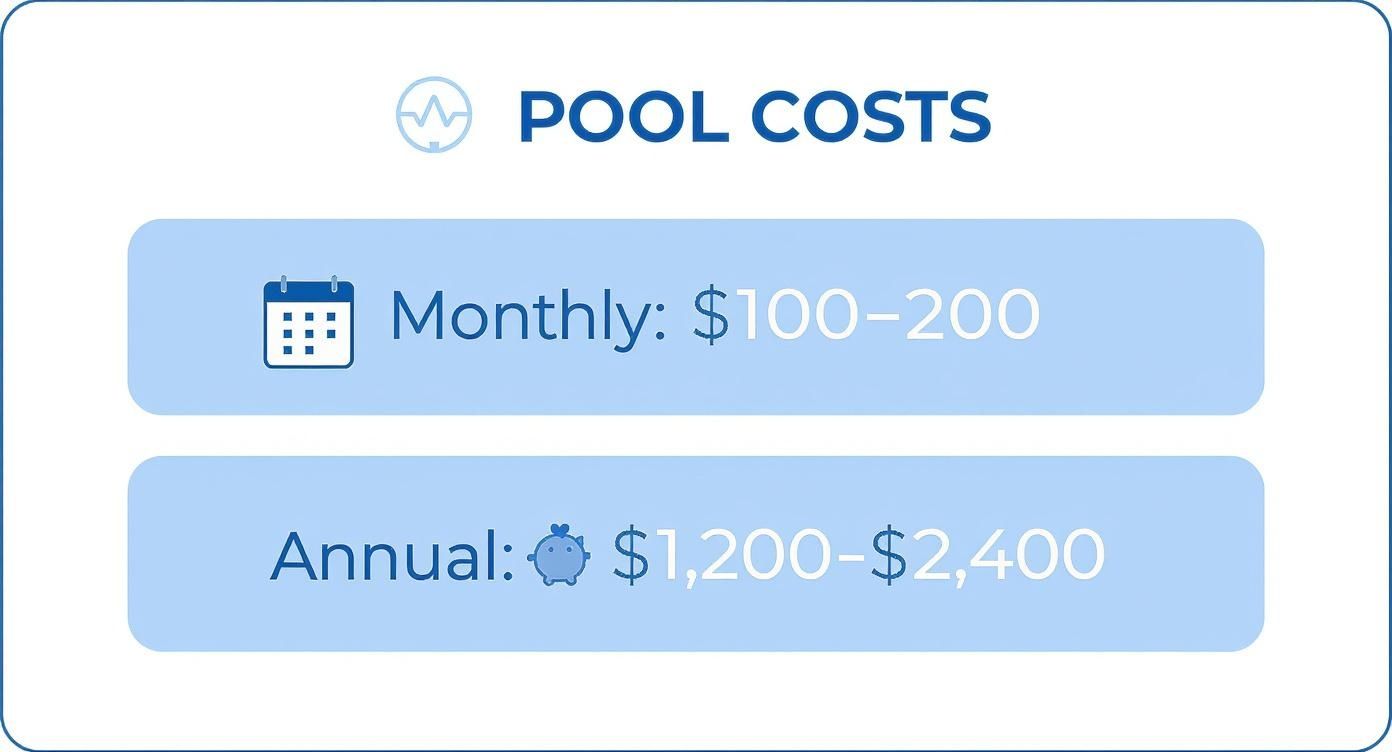
As you can see, popping a couple of hundred dollars aside each month will put you right in the ballpark for standard, hassle-free maintenance.
We’ve also put together a simple table to show you where that money is likely to go over a full year. It’s a great way to see the main expense categories at a glance.
Estimated Annual Pool Maintenance Costs at a Glance
This table gives you a summary of the typical yearly costs for keeping a standard residential swimming pool in Australia sparkling and healthy.
| Expense Category | Estimated Annual Cost Range (AUD) |
|---|---|
| Chemicals & Salt | $400 – $800 |
| Electricity (Pump/Filter) | $500 – $1,200 |
| Professional Servicing | $600 – $1,500 (if you hire help) |
| Minor Repairs & Parts | $200 – $500 |
| Water Top-Ups | $50 – $150 |
This gives you a solid foundation. You can see how the cost to maintain a pool is really a combination of several smaller, ongoing expenses. With these key figures in your head, you can start planning your budget with a bit more confidence.
How Your Pool Can Silently Drain Your Power Bill
Let's talk about the silent partner in your pool running costs. Your electricity bill. It’s so easy to focus on the chemicals you can see and the cleaning gear you can hold, but the energy needed to keep that beautiful water circulating and clean… well, that can quietly sneak up on you.
This is a huge part of the overall cost of maintaining a pool. But it’s not something to be scared of. It's just something to be smart about.
So, let's pull back the curtain on how much your pump, filter, and heater are actually adding to your quarterly power costs. With a little knowledge, you can make some simple changes that really add up.
The Heartbeat of Your Pool: The Pump
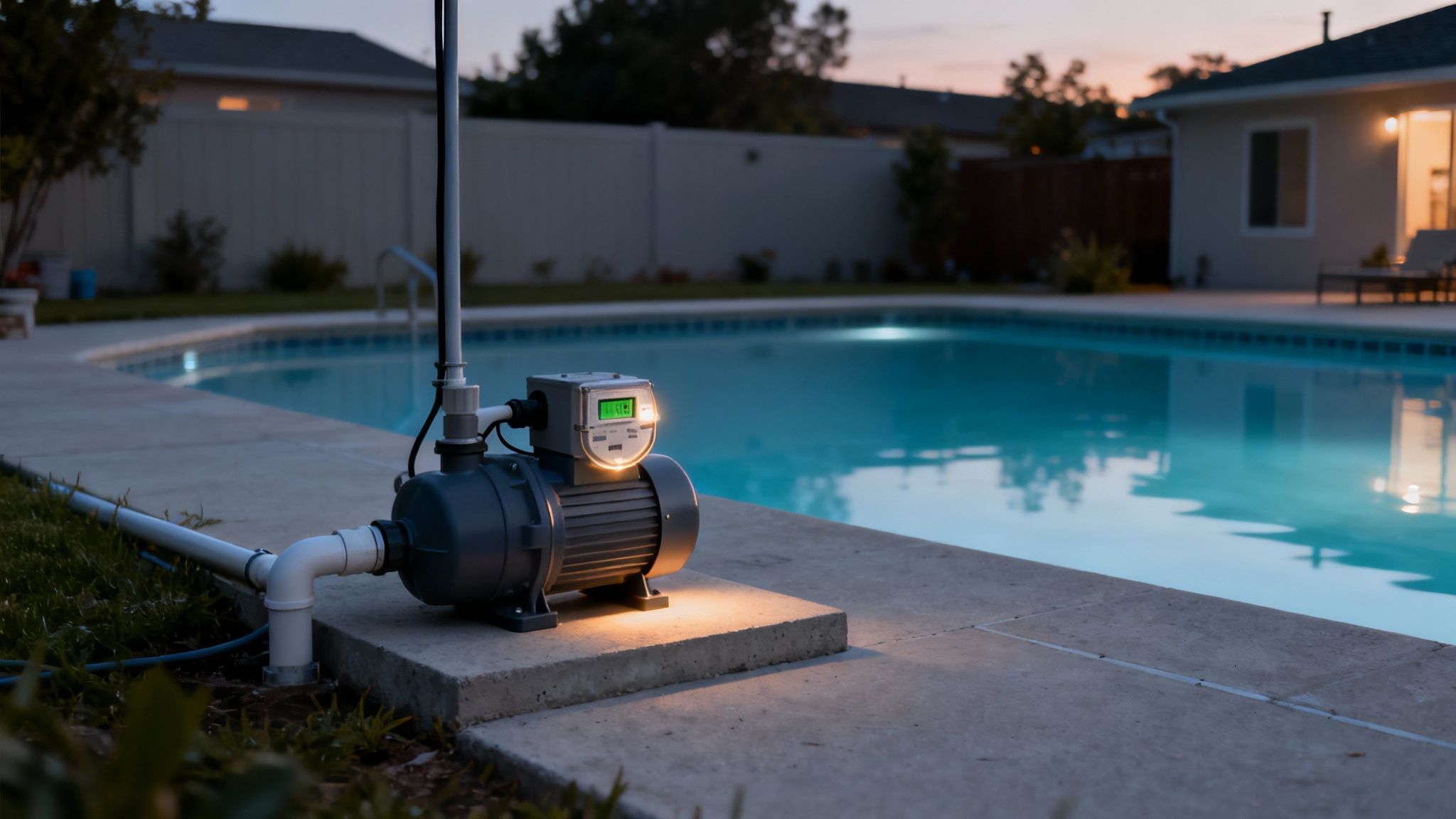
Think of your pool pump as its heart. It’s the single most important piece of equipment you've got, tirelessly pumping water through the filter to keep it all clean and clear. And because it runs for hours every single day, it's also the biggest energy user on the block.
Your pump is responsible for a massive chunk of your pool's electricity consumption. Seriously. For many Aussie households, the pool pump can be the second-biggest energy guzzler right after the air conditioner.
That’s why the type of pump you have makes such a massive difference.
- Single-Speed Pumps: These are the old workhorses. They have one speed: full throttle. They're cheaper to buy upfront, but they run at maximum capacity all the time. It’s a bit like driving your car everywhere in first gear.
- Variable-Speed Pumps: These are the smart, modern option. You can adjust their speed, running them at a lower, more energy-efficient rate for regular filtration and only ramping them up when you need to… like for vacuuming or running a cleaner.
Upgrading from a single-speed to a variable-speed pump can slash your pump's energy use by as much as 70%. While the initial cost is higher, the savings on your power bill often pay for the new pump in just a few years.
The Cost of Warmth: Pool Heaters
If you live in a cooler part of Australia or you just want to stretch out your swimming season, a pool heater is a fantastic luxury. But that luxury comes at a price. And that price is measured in kilowatts.
Electric and gas heaters are powerful. They can heat your pool quickly. The catch? They are also pretty expensive to run, potentially adding hundreds of dollars to your bills each month during the cooler seasons as they fight the natural cooling that happens overnight.
This is where solar heating becomes a really interesting alternative.
Making Smart Energy Choices
A solar heating system definitely has a higher upfront installation cost. There's just no getting around that. But its running costs are practically zero because it uses the sun’s free energy to warm your water. Over its lifespan, a solar heater can save you a huge amount of money compared to electric or gas options.
But it’s not just about big upgrades. Small habits make a big difference, too.
- Run your pump during off-peak hours. Have a chat with your energy provider. Running your pump overnight or during designated off-peak times can significantly cut your electricity rate.
- Get a good quality pool cover. A cover is your best friend. It stops water from evaporating (saving on water bills) and dramatically reduces heat loss, which means your heater doesn't have to work nearly as hard.
- Keep your filters clean. A clogged filter makes your pump work harder and use more energy to push water through. Regular cleaning is an easy win for your power bill.
By understanding where the power goes, you can take control of your bills and make sure the cost to maintain your pool stays comfortably within your budget.
Decoding Your Pool Chemical Shopping List
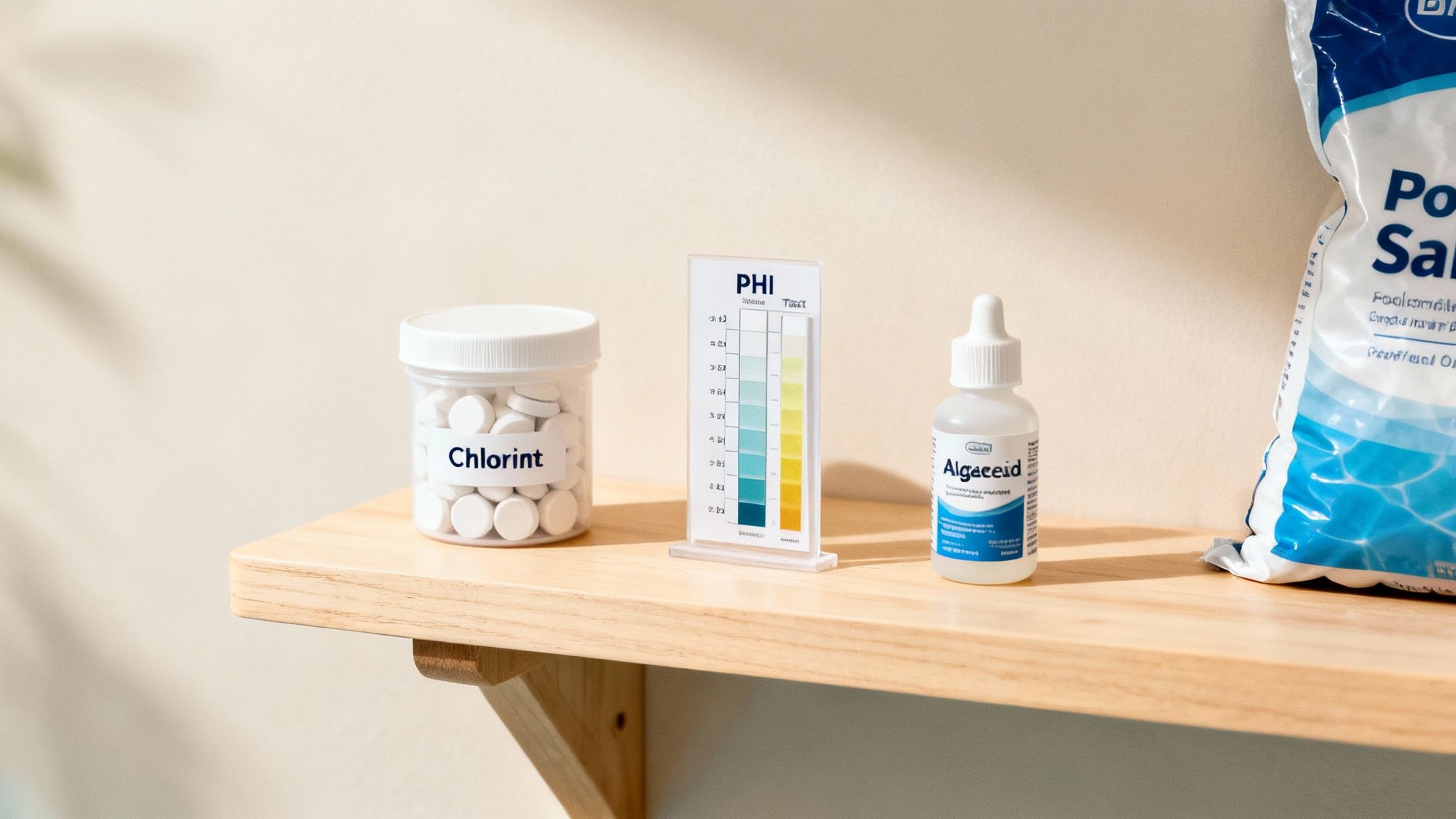
Walking into the pool shop can feel a bit like stepping into a science lab, can't it? Giant tubs of chlorine, mysterious bottles of algaecide, and huge bags of salt are all staring back at you. It’s pretty easy to feel overwhelmed.
What do you actually need? And more importantly, how much is this all going to set you back?
Let's demystify your pool chemical shopping list. We’ll keep it simple and break down what each essential chemical does… from keeping the water safe to stopping it from turning a nasty shade of green. Getting a handle on this is the first real step to figuring out the true cost to maintain your pool.
The Big Two: Chlorine vs Saltwater Pools
Before we get into specific chemicals, we need to talk about your pool's system. Most backyard pools in Australia fall into one of two camps: traditional chlorine or saltwater. This choice is the single biggest factor that will shape your ongoing chemical costs.
Quick tangent here… a lot of people think saltwater pools don't use chlorine. That's a common myth. They actually use a device called a salt chlorinator (or salt cell) to convert dissolved salt in the water into chlorine. So you're still sanitising with chlorine, you're just producing it on-site instead of adding it from a tub.
Now, let's see how that affects your wallet.
- Traditional Chlorine Pools: You manually add chlorine, usually as tablets, granules, or liquid. It's a hands-on process that needs regular testing and dosing to get right.
- Saltwater Pools: You add large bags of salt directly to the pool, and the chlorinator converts it into a steady, low level of chlorine. It's a more automated, set-and-forget system.
The financial trade-off is pretty clear. Chlorine pools have a lower upfront cost but higher ongoing chemical expenses. Saltwater pools cost more to set up (thanks to that fancy chlorinator) but are generally cheaper to run month-to-month.
Your Essential Chemical Toolkit
Regardless of your pool type, there's a core group of chemicals you'll need to keep on hand. Think of these as the non-negotiables for a healthy, sparkling pool. Your actual monthly spend on these can range from $30 to $80, depending on your pool size, how often it's used, and the local climate.
Here’s what you’ll be buying:
- Sanitisers (Chlorine/Salt): This is the hero chemical that kills bacteria, viruses, and other nasties. For a chlorine pool, expect to spend $25 to $50 a month. For a saltwater pool, your main cost is the initial salt dump and occasional top-ups, which might only be $100 to $200 a year.
- pH Balancers (Acid/Alkali): Keeping your pH level right is crucial for swimmer comfort and making sure your chlorine works effectively. You’ll need pH increaser (soda ash) and pH decreaser (hydrochloric acid or dry acid). Budget around $10 to $20 a month for these.
- Alkalinity Increaser: This acts as a buffer for your pH, stopping it from swinging wildly. You won't use it all the time, but it's essential to have.
- Algaecide: This is your insurance policy against green water. A regular preventative dose can save you from a costly and time-consuming algae bloom, especially after heavy rain or a big pool party.
- "Shock" Treatment: This is basically a super dose of sanitiser. You use it to oxidise contaminants (like sweat and sunscreen) and clear up cloudy water. You’ll shock the pool every few weeks or after heavy use.
A well-balanced pool not only looks and feels better, but it also saves you money. When your pH and alkalinity are correct, your chlorine works much more efficiently, meaning you'll use less of it over time.
Getting the chemical balance right is the heart of affordable pool care. It stops small issues from becoming big, expensive problems. And when you factor it in, you get a much clearer picture of the total cost to maintain a pool each year.
DIY Pool Care Versus Hiring a Professional
Alright, this is the big one. The question every pool owner asks themselves at some point. Should you roll up your sleeves and handle it yourself, or is it better to pay someone to take care of it for you?
Honestly, there’s no single right answer here. It’s the classic trade-off between your time and your money. It all comes down to your budget, how much free time you've got on your hands… and whether you actually enjoy the process of looking after your pool.
Let's break down the real-world costs of both paths so you can figure out what makes the most sense for your life.
The Do-It-Yourself Approach
Going the DIY route is a great way to save money on labour, but you can’t escape the costs entirely. It’s more of a pay-as-you-go situation, with some upfront costs for gear and then the ongoing expense of chemicals. And, of course… your time.
Think of it like cooking at home versus getting takeaway. It's cheaper, for sure. But you've got to buy the groceries and do all the prep work yourself.
Here's what your initial shopping list will probably look like:
- A Quality Water Testing Kit: This is your most important tool. A good one will run you $50 to $100 and is absolutely non-negotiable for keeping your water safe.
- Telescopic Pole: The backbone of your cleaning gear. This will set you back about $50 to $80.
- Essential Attachments: You'll need a leaf scoop/skimmer head ($20 – $40), a pool brush ($30 – $60), and a vacuum head ($40 – $100).
- Chemical Storage: A safe, lockable storage container is a must-have to keep chemicals away from kids and pets.
Once you’re set up, your main ongoing commitment is time. You'll need to set aside at least 1-2 hours every week for testing water, balancing chemicals, skimming leaves, and giving the pool a proper brush and vacuum.
Hiring a Pool Professional
Now for the other side of the coin. Hiring a professional pool service is the ultimate convenience. Your pool stays sparkling clean and perfectly balanced without you having to lift a finger. You just get to come home and enjoy it.
It's like having a gardener for your pool. You don't have to worry about the weeds… or in this case, the algae.
For a standard fortnightly service here in Australia, you can expect to pay anywhere from $70 to $120 per visit. A more frequent weekly service will naturally cost a bit more. This fee usually covers the labour for:
- Testing and balancing the water chemistry
- Emptying the skimmer and pump baskets
- Brushing the pool walls and steps
- Checking all the equipment to make sure it's running correctly
One crucial thing to check is whether the service fee includes the cost of chemicals. Some companies roll all standard chemicals into their price, while others will bill you for them separately. Always ask this question upfront to avoid any nasty surprises on your invoice.
A professional service essentially removes the guesswork and the time commitment from your plate. It's a fantastic option if you're time-poor or if you'd just rather spend your weekends swimming than scooping. It’s not unlike deciding how much to budget for window cleaning service costs; you’re paying for expertise and for someone else to handle a job you’d rather not do yourself.
The right choice really boils down to your priorities. If you enjoy being hands-on and want to minimise your monthly spend, DIY is a great fit. But if your time is your most valuable asset and you want guaranteed results, investing in a professional service is often money well spent.
Budgeting for Long-Term Repairs and Upgrades
Owning a pool is a bit like a long-term relationship. It’s not just about the fun summer dates… you’re in it for the long haul. And like any long-term commitment, things will eventually need a tune-up or even a full replacement. This isn't part of your regular monthly running costs. This is the bigger picture stuff.
We’re talking about the costs that pop up down the track. Things like fixing a stubborn leak that just won’t quit, replacing a pump that’s finally given up the ghost, or even giving the whole pool a facelift by resurfacing it after a decade or two.
These aren't everyday expenses, but they can be significant. So, it's really smart to plan for them. Think of it as creating a 'rainy day' fund for your pool, so a sudden repair doesn't turn into a major financial headache.
The Lifespan of Your Pool Gear
Nothing lasts forever. Especially equipment that’s working hard day in and day out, exposed to water, chemicals, and the Aussie sun. Knowing the average lifespan of your key pool components is the first step in creating a realistic long-term budget.
It’s a bit like owning a car. You know you’ll eventually need new tyres and a new battery, you just don't know the exact day. It’s the same with your pool gear.
Here’s a rough guide to how long you can expect the major parts to last:
- Pool Pump: The workhorse of your system. A good quality pump should give you 8 to 12 years of faithful service before it needs a major repair or replacement.
- Pool Filter: Whether you have a sand, cartridge, or diatomaceous earth (DE) filter, the main tank can last for well over a decade. However, the internal components have shorter lives. You'll likely need to replace filter cartridges every 3-5 years or change the sand in a sand filter every 5-7 years.
- Saltwater Chlorinator: The salt cell inside your chlorinator is the part that does all the work, and it typically needs replacing every 3 to 7 years.
- Pool Heater: This can vary wildly depending on the type. A gas or heat pump heater might last 7-12 years, while a well-maintained solar heating system can last for 15-20 years or more.
Being prepared for these larger, less frequent expenses is the real secret to stress-free pool ownership. It keeps the joy in it, you know?
Planning for Major Pool Repairs
Beyond the equipment, the pool structure itself will eventually need attention. This is especially true for certain types of pools. For example, a concrete pool might develop small cracks over time that need professional attention before they become bigger problems.
The journey with a concrete pool often starts with a higher upfront investment, but the maintenance story continues with costs for cleaning, chemicals, and eventual repairs. When structural issues like cracks pop up, fixing them can cost anywhere from $1,000 to $5,000. A perfect example of a cost you need to plan for. You can find more insights on what it costs to own a pool in Australia on Three Birds Renovations.
A good rule of thumb is to set aside 1-3% of your pool's initial installation cost each year into a dedicated savings account. If your pool cost $60,000 to install, that means putting away between $600 and $1,800 annually for these future big-ticket items.
This approach transforms a potential emergency into a manageable, planned expense. It’s a bit like how some people budget for big household projects or even an end-of-lease clean cost when they know a move is on the horizon. Planning ahead removes the sting. When your pump finally fails in year nine, you'll have the funds ready to go without derailing your entire household budget.
Smart Ways to Reduce Your Pool Running Costs
Okay, we've talked a lot about the costs. Now for the fun part… how to shrink them.
Owning a pool doesn't have to mean your bank account takes a nosedive every summer. There are so many clever ways to be more efficient and trim that budget without sacrificing a single drop of sparkling, clean water. This is all about working smarter, not harder.
Cover Up to Save Big
If you take only one piece of advice from this entire guide, let it be this: get a good quality pool cover. Seriously. It is the single most effective way to lower the cost to maintain your pool. A cover is like putting a lid on a pot of water… it stops all the good stuff from escaping.
A good cover can slash water evaporation by up to 97%. Just think about that for a second. It means you’re not constantly paying to top up the water, and you're also dramatically cutting down on chemical loss.
A pool cover is your best friend for another reason: heat retention. It can reduce your pool's heating costs by 50-70% because it traps the sun's warmth and stops it from disappearing overnight. It’s a non-negotiable for saving money.
Upgrade Your Gear for Long-Term Wins
Another smart move is to invest in energy-efficient equipment. Yes, the upfront cost for a variable-speed pump is higher than a basic single-speed model. But the long-term savings on your power bill are massive, often paying for the upgrade itself within a few years.
Simple habits also make a surprisingly big difference to your bottom line.
- Keep your filters clean. A clogged filter forces your pump to work overtime, chewing through electricity. A quick backwash or hose-down is an easy win.
- Maintain your surroundings. Keep trees and shrubs trimmed back to reduce the amount of leaves and debris that end up in the water. Less mess means less cleaning time and less strain on your filter.
- Run your pump during off-peak hours. A simple timer can ensure your filtration cycle runs when electricity rates are at their lowest.
These simple strategies, from a good cover to keeping things clean, help keep your running costs predictable. It’s similar to how regular upkeep around your home can prevent bigger bills, a concept we explore in our guide on the average cost of pressure cleaning. It's all about small, consistent actions that deliver big savings.
Frequently Asked Questions About Pool Costs

It's completely normal to have a few lingering questions when you're trying to nail down the real cost of keeping a pool. We get it. To help clear things up, we've put together some of the most common queries we hear from pool owners.
Think of this as a final chat to make sure you've got all the facts straight.
Are Saltwater Pools Really Cheaper to Run?
This is probably the number one question we're asked. The short answer is… yes, usually. While you have a higher upfront cost for the salt chlorinator unit itself, your ongoing chemical expenses are significantly lower.
You'll find yourself buying large, fairly cheap bags of salt just a couple of times a year, instead of shelling out for expensive buckets of chlorine every other month. Over the long haul, a saltwater system will almost always save you money on chemicals.
What's the Biggest Surprise Cost for New Pool Owners?
Honestly, the biggest shock isn't usually one single big-ticket item. It's the way all the small, unexpected things add up. A sudden algae bloom after a week of heavy rain, a split vacuum hose that needs replacing, or a tiny leak from a fitting that goes unnoticed for a while.
The other big one is the first major equipment failure. Most people budget for their monthly running costs but forget to put a little aside for that day, five or ten years down the track, when the pump or chlorinator gives up. Planning for those eventual replacements is crucial.
One of the driving forces behind private pool ownership in Australia is simply access. As our communities grow, the distance to public swimming facilities is increasing for many families, making a backyard pool a more practical option for daily summer fun.
This trend is a big reason why understanding the personal cost to maintain a pool is so important. A 2025 report found that over 6 million Australians already live more than a 10-minute drive from a public pool, a number expected to climb to 7.3 million by 2032. You can read more about these findings from Royal Life Saving WA.
Do Pool Costs Change Much Between Summer and Winter?
Absolutely. Your costs will be worlds apart in summer compared to winter. You're running the pump for longer hours, using far more sanitiser to fight off the sun and cope with heavy use, and possibly spending money on heating the water.
In winter, you can often halve your pump's run time and drastically cut back on your chemical use. Most pool owners find their winter maintenance bills are less than half of what they spend during the peak of summer.
Keeping a pool in top condition is one thing, but ensuring the rest of your property is just as pristine is another. For everything beyond the pool fence, from sparkling office windows to complex commercial cleaning, That Cleaning Crew provides professional, reliable solutions across Sydney and surrounding regions. Request your free on-site quote today.