Ever found yourself looking at a less-than-sparkling space and thinking, "I could do a much better job"? That little thought… that’s often where the journey begins. It’s more than just knowing how to clean; it’s about the drive to build something from scratch, something that's truly yours.
The whole process can be broken down into a few key moves. Picking your niche. Sorting out the legal stuff like your ABN and insurance. And then going out to land those first few clients. It all kicks off with that initial idea that you can provide a fantastic service people will happily pay for.
Is Starting a Cleaning Business Right for You?
Before we get into the nitty-gritty of business plans and insurance policies, let's just chat about whether this path is a good fit for you. Think of it as dipping your toe in the water before you dive in. This isn't just about trading your time for money; it's about creating a service, a brand, and a reputation you can be proud of.
Finding Your Place in a Growing Industry
You might be wondering if there's even room for another cleaning business. Good question. The good news is, the demand is definitely there and it's growing. It’s not just about homes anymore… opportunities are everywhere.
- Residential Cleaning: This is often the starting point. Think busy families, professionals who are short on time, or people who just want their weekends back.
- Commercial Cleaning: This is a whole different ball game. Offices, retail shops, and medical centres all need reliable cleaners to keep their spaces professional and hygienic. If you want to dive deeper, you can learn more about what commercial cleaning involves in our detailed guide.
- Specialised Services: This is where you can really stand out. Think end-of-lease cleans, post-construction cleaning, or even eco-friendly cleaning services.
The market in Australia is quite healthy. In fact, starting a cleaning business here can be a great move. As of 2025, there are around 45,014 commercial cleaning services businesses in Australia, which is a 2.4% increase from the year before. This growth, tracked by industry reports from IBISWorld, shows a steady demand for professional cleaning.
This simple flow shows the journey from a simple idea to a firm decision.
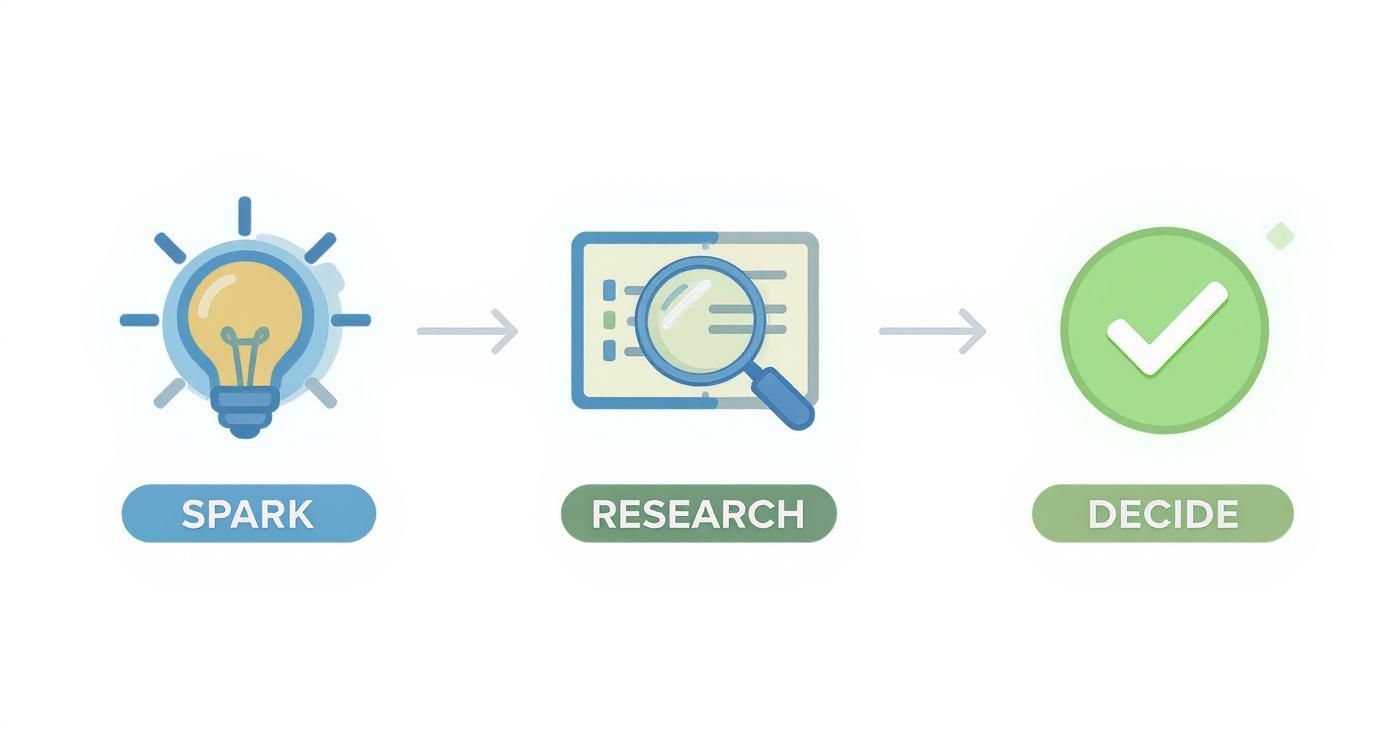
Seeing it laid out like that makes the process feel much more manageable, doesn't it? It’s a reminder that every successful business starts with that initial spark, followed by solid research and a clear decision. It's a journey, not a race.
Crafting Your Cleaning Business Plan
Right, let's get practical. A dream without a plan is just a wish, and we’re here to build a real business. Don't worry, I’m not talking about some stuffy, 50-page document that you’ll write once and then shove in a drawer to collect dust. We're creating a simple, usable blueprint. A road map that will guide your decisions and keep you on track.
It’s like planning a road trip. You wouldn’t just jump in the car and start driving, hoping you end up somewhere great. You’d figure out your destination, check the fuel, and map out the route. Your business plan is exactly that.
Finding Your Niche
First things first, who are you going to clean for? Saying "everyone" is a trap. It's like trying to be everyone's best friend… you end up not really connecting with anyone. The key is to find your niche. Your corner of the market where you can really shine.
So, what’s your style?
- Residential Homes: This is often the most common starting point. You're helping busy families or professionals reclaim their weekends, and that feels good. The work is personal, and a happy client can quickly lead to referrals around the neighbourhood.
- Commercial Spaces: This could be anything from a small real estate office to a bustling cafe. Commercial clients often mean bigger, recurring contracts, which is fantastic for predictable income. It often involves after-hours work, which can be a plus or a minus depending on your lifestyle.
- Specialised Services: This is where you can become the go-to expert. Think bond cleans for rental properties, deep cleans for medical clinics, or even eco-friendly cleaning using only non-toxic products. These services often command higher prices because they require specific skills and attention to detail.
Deciding on your niche helps you focus your energy. If you're targeting commercial offices, for instance, you'll need to know exactly what they expect. Having a solid commercial cleaning checklist is a great starting point to show clients you're a true professional.
A focused business is a memorable business. When you try to serve everyone, you risk becoming a forgettable jack-of-all-trades. When you specialise, you become the first person people think of for a specific need.
Talking Real Numbers
Now for the part that can feel a bit scary… the money. But trust me, facing the numbers now will save you so many headaches later on. Knowing your startup costs helps you figure out how much you need to get going and how to price your services for actual profit. We're not just covering our time. We're building a sustainable business.
The initial investment can vary a lot, but you can get started for less than you might think. A solo operator can often get legally set up and equipped for under $2,000. The key is to distinguish between the must-haves and the nice-to-haves.
Let's break down some of the typical costs you’ll need to budget for.
Estimated Startup Costs for a Cleaning Business
Here's a breakdown of common one-off and ongoing expenses to help you budget for your new cleaning venture in Australia.
| Expense Category | Estimated Cost (Low End) | Estimated Cost (High End) | Notes |
|---|---|---|---|
| Business Registration | $50 | $150 | This covers registering your business name and ABN. |
| Public Liability Insurance | $400 | $800 | This is an annual cost and an absolute non-negotiable. |
| Basic Equipment | $300 | $700 | Includes a quality vacuum, mop, buckets, and caddy. |
| Initial Supply Kit | $150 | $300 | Microfibre cloths, sponges, and professional-grade cleaning solutions. |
| Vehicle Expenses | $100 | $500+ | Fuel, potential signage, and maintenance. This varies wildly. |
| Simple Marketing | $50 | $250 | Think business cards, flyers, or a basic online presence. |
Seeing it all laid out like this makes it feel much more manageable, right? It's not some huge, impossible figure. With just a handful of initial jobs, you can cover these startup costs and start turning a real profit. This simple budget is the foundation of your business plan, turning your great idea into a tangible reality.
Getting Your Registrations and Insurance Sorted
Let's get into the paperwork. I know, this is the part that feels a bit dry, maybe even a little intimidating. But trust me on this. Getting your setup right from day one is like pouring a solid foundation for a house. Everything else is built on it, and it will save you a world of headaches down the track.
Think of these steps as the moments your business becomes real. This is where you shift from having a good idea to becoming a legitimate, professional operator that clients can trust completely.
So, let's break it down into simple, manageable pieces.
Choosing Your Business Structure
First, you need to decide how your business will be legally set up. In Australia, the two most common paths for a new cleaning business are going the sole trader route or registering as a company. They both have their pros and cons, and the right choice really boils down to your long-term goals.
- Sole Trader: This is the simplest and most popular way to start. You are the business. All profits are your personal income, and you're personally responsible for any debts. It’s incredibly straightforward to set up, and the admin is much easier to manage.
- Company (Pty Ltd): Setting up a company creates a separate legal entity. The business becomes its own 'person', which means your personal assets are generally protected if the business runs into trouble. It's more complex and costly to manage, but it’s the way to go if you have big plans for growth and hiring staff.
For most people just starting out, the sole trader path is the perfect fit. It’s low-cost and lets you get up and running quickly without getting bogged down in complex paperwork. You can always change to a company structure later as your business grows.
Making It Official with an ABN and Business Name
Once you've settled on a structure, it's time to get your Australian Business Number (ABN). This is a unique 11-digit number that identifies your business to the government. It's completely free to register for an ABN, and you absolutely need one to operate professionally and issue proper invoices.
Next up is your business name. If you plan to operate under a name that isn't your own (like "Sparkle Bright Cleaning" instead of just "Jane Smith"), you must register it with the Australian Securities and Investments Commission (ASIC). This involves a small fee but it secures your brand name.
Think of your ABN as your business's birth certificate and your registered name as its official title. These are the non-negotiables that prove you're a serious, professional service provider.
The One Insurance Policy You Absolutely Can't Skip
Now for something really important. Insurance. Specifically, Public Liability Insurance. If you take only one piece of advice from this entire section, let it be this: do not clean a single property without it.
Public liability insurance is your safety net. It protects you if you accidentally cause injury to someone or damage their property while you're on the job. Imagine you knock over an expensive vase… or a client slips on a freshly mopped floor. Without insurance, the cost of that one accident could put you out of business before you've even started.
A decent policy with around $5 million to $10 million in cover can cost between $400 and $800 a year. It might feel like a big expense when you're just starting out, but the peace of mind it gives you, and the protection it offers, are priceless. It also shows clients you’re a professional who takes responsibility seriously.
Getting Equipped and Landing Your First Clients
Alright, you’ve got the plan and the paperwork is sorted. Now for the exciting part. Gearing up and actually getting out there. This is the moment your business stops being an idea on paper and starts feeling real.
Let's talk about the tools of the trade. It's so easy to get carried away and think you need every fancy gadget under the sun. You don't. The goal here is to invest your money where it counts, on quality gear that delivers a professional result without breaking the bank.
Building Your Starter Toolkit
You can achieve a fantastic, professional-level clean with a surprisingly simple set of equipment. The key isn't quantity; it's quality. A cheap vacuum that leaves dust behind or flimsy cloths that just push dirt around will only make your job harder and leave clients thoroughly unimpressed.
Here’s a list of the absolute must-haves to get you started:
- A Solid Vacuum Cleaner: This is your workhorse. Look for one with excellent suction, good filtration (like a HEPA filter), and a variety of attachments for different surfaces and tight corners.
- High-Quality Microfibre Cloths: Get a big stack of them in different colours. This allows you to colour-code for different areas… like blue for glass, yellow for kitchens, and red for bathrooms… to prevent cross-contamination. It’s a small detail that shows clients you’re a true professional.
- A Reliable Mop and Bucket System: A good spin mop or a modern flat mop system is leagues ahead of an old-school string mop. They’re more effective, hygienic, and look far more professional.
- A Cleaning Caddy: Think of this as your mobile command centre. It keeps all your spray bottles, cloths, and small tools organised and within arm's reach, saving you from running back and forth to your car.
You'll also need a basic but effective set of professional-grade cleaning solutions. Start with a great all-purpose cleaner, a streak-free glass cleaner, a powerful bathroom disinfectant, and a solid degreaser for kitchens.
Finding That First Paying Client
With your gear ready to go, the big question looms: how do you actually find someone to pay you? This can feel like the scariest step, but honestly, it’s simpler than you might think. You don't need a massive marketing budget to get the ball rolling.
Your first clients will almost always come from your existing network. It all comes down to trust. People are far more likely to hire someone they know, or who comes recommended by a friend they trust.
Start by telling everyone you know what you're doing. Let your friends, family, and former colleagues know you've launched a professional cleaning business. You'd be surprised who needs help or knows someone who does.
Don't be shy about promoting yourself in the beginning. Your enthusiasm is your biggest asset. People buy from people they know, like, and trust, and a personal recommendation is the most powerful marketing tool on the planet.
Another great place to start is in local community groups online. Join your local suburb's Facebook group and post a friendly, genuine introduction. Consider offering a special introductory rate for the first few clients in your area. The immediate goal is just to get your foot in the door and let your amazing work speak for itself.
Setting Your Prices for Profit
Okay, let's talk money. How much should you charge? This is where so many new business owners stumble. They charge way too little, thinking it will help them win jobs.
My advice? Don't charge by the hour. It actually punishes you for becoming faster and more efficient at your job. Instead, price by the job. Visit the client's home or office, assess the scope of the work, and provide them with a flat-rate quote. This approach looks far more professional, and the client appreciates knowing the exact cost upfront.
When you're starting out, aim for an effective hourly rate of at least $35-$50 per hour for standard residential cleaning. For more specialised, labour-intensive jobs like an end-of-lease clean, that rate can and should be higher. If you need a hand figuring out everything that goes into a job like that, our end-of-lease cleaning checklist provides a fantastic breakdown of what's involved.
The market has also seen some interesting shifts lately. The COVID-19 pandemic really changed how people think about cleanliness, leading to a much higher demand for professional, high-standard cleaning services. While the industry saw an initial dip when businesses closed, the rebound has created new opportunities for cleaners who offer specialised, hygiene-focused solutions.
Once you have a few happy clients under your belt, don't be afraid to ask them for reviews and referrals. A glowing testimonial on your website or a local directory is pure gold. Before you know it, word-of-mouth will become the engine that drives your business forward, bringing you new clients with almost no effort.
Scaling Your Business for Long-Term Success

So, you’ve landed a few clients. The phone is starting to ring, and the schedule is filling up. That’s a fantastic feeling, isn't it? But how do you turn this initial buzz into a business that lasts for years to come?
It’s all about shifting your mindset. You're no longer just the person doing the cleaning. You're the person running the business. This means creating systems that can grow with you and delivering an experience that turns one-off clients into loyal fans who rave about you.
Creating an Amazing Client Experience
Think about the best service you’ve ever received. It probably wasn’t just about the final result; it was the little things. The friendly communication, the attention to detail, the feeling that they genuinely cared.
That’s exactly what we’re aiming for here. A happy customer isn't just a source of revenue. They are your most powerful marketing asset. They’re the ones who will leave glowing reviews and tell their friends about you over coffee.
So, how do you create that?
- Consistency is everything. Develop a simple checklist for every single job. This ensures that whether it's you or a future employee doing the work, the result is always the same high standard your clients expect.
- Communicate like a real person. A quick text to let them know you’re on your way makes a world of difference. Following up the next day to make sure they’re thrilled with the result shows you care beyond just getting paid.
- Go one tiny step further. Did you notice their bin was overflowing? Take it out for them. It takes ten seconds but leaves a lasting impression that you’re thoughtful and proactive.
This is how you build a reputation that gets people talking. And in a service business, that's pure gold.
Knowing When to Hire Your First Employee
The thought of hiring someone can be terrifying. It’s your baby, after all. How can anyone else care as much as you do? But eventually, you'll hit a ceiling. There are only so many hours in a day, and you can’t be in two places at once.
The moment you start turning down good work because you’re fully booked is the moment to seriously consider hiring. It’s a huge step, but it’s the only way to grow beyond what you can personally handle. This is the move that prevents burnout and allows your business to actually scale.
Finding the right person is about more than just their ability to clean. You're looking for someone with a great attitude who is reliable and trustworthy. You can teach someone to clean your way, but you can’t teach them to be a good person.
The decision to hire is the first step in transforming your job into a real, scalable business. It's you, the founder, moving from working in the business to working on the business.
Putting Simple Systems in Place
As you get busier, you can't keep everything in your head. Trying to manage schedules, invoices, and client details on scraps of paper or in your phone’s notes app is a recipe for disaster. It's time to put some simple systems in place to keep things organised and professional.
You don't need complicated, expensive software to start. A few simple tools can make a world of difference:
- Scheduling: A shared digital calendar like Google Calendar works perfectly. You can colour-code jobs, add client notes, and set reminders so nothing ever slips through the cracks.
- Invoicing: Use a simple, free accounting tool to create professional-looking invoices and track payments. This not only makes you look more professional but makes tax time about a million times easier.
- Client Management: A basic spreadsheet is all you need to keep track of client information. Note down their address, contact details, specific requests, and even the name of their dog. Remembering those little details makes clients feel valued.
These simple systems are the backbone of a professional operation. They free up your mental energy so you can focus on the important stuff, like growing your business and keeping your clients happy. The Australian cleaning services market is growing steadily, with a market value of AUD 18.05 billion in 2024 and projected growth. This means there’s plenty of opportunity for well-organised businesses to find their niche and succeed. You can find out more about these trends and explore the full Australian cleaning services market report.
Common Questions About Starting a Cleaning Business

We've covered a lot of ground together, from putting a business plan on paper to the buzz of landing your first clients. It’s a big journey. So, it's completely normal if you still have a few questions buzzing around.
Honestly, that's a good thing. It means you're thinking this through properly.
Let's tackle some of the most common things people ask when they're figuring out how to start a cleaning business. I'll give you some straight, simple answers to help you move forward with confidence.
How Much Can I Realistically Earn?
This is the big one, isn't it? The honest answer is… it really varies, especially in your first year. Your income is a mix of your pricing, how many clients you have, and how well you manage your expenses.
But let’s talk numbers.
- For standard residential cleaning, a good starting point is to aim for an effective hourly rate of $35 to $50 per hour.
- When you move into specialised areas like bond cleans or detailed commercial jobs, that rate can easily climb to $55 to $80 per hour, sometimes even more.
A hard-working solo operator who gets their systems right could aim for an annual income anywhere from $60,000 to over $100,000 once they're properly established. The key is to price for profit. Always remember to factor in your travel time, the cost of supplies, your insurance premiums, and setting aside money for tax.
Do I Need Any Special Licences?
Good news on this front. For general residential or commercial cleaning in Australia, you typically don't need a specific "cleaning licence" to get started. It's not like being an electrician or a plumber where you need a formal trade qualification.
However, there are a few absolute non-negotiables.
You must have an Australian Business Number (ABN) and register your business name if you aren't trading under your own personal name. These are the steps that make you a legitimate, professional business in the eyes of the government and your clients.
Some specialised situations do require extra checks. For instance:
- Working with Vulnerable People: If you plan to clean places like childcare centres or aged care facilities, you'll almost certainly need a current police check or a Working with Children Check.
- Specific Industries: Highly specialised work, like cleaning active construction sites (which requires a White Card) or offering pest control, will have its own set of certification requirements.
Always double-check the specific rules in your state or territory, just to be safe.
What Is the Biggest Mistake New Owners Make?
That's a fantastic question because learning from others' mistakes is so much cheaper than making them yourself! I'd say there are two common traps that new business owners fall into.
The first is pricing their services way too low just to win those first few jobs. It's a tempting strategy, but it can backfire badly. You end up setting a low value for your work and often attract clients who only care about the cheapest price, not about the quality you provide.
The second major mistake is skipping the proper insurance from day one. It can feel like an unnecessary expense… right up until the moment something goes wrong. A single accident could sink your business before it even gets off the ground.
Start professionally from the beginning. Price yourself for the value you deliver and get that public liability insurance sorted before you pick up a single microfibre cloth.
Should I Focus on Residential or Commercial Clients First?
This really comes down to your personal goals, your lifestyle, and what kind of work you enjoy most. There’s no single right answer, but here’s how they generally compare.
Residential Cleaning:
This is often the easier entry point. You're usually dealing with one decision-maker, the jobs are smaller, and you can build a client base quite quickly through local word-of-mouth. The work is also typically done during standard daytime hours, which can be great for work-life balance.
Commercial Cleaning:
This side of the industry can provide larger, more stable contracts. Think offices, retail stores, or medical clinics. This often means more consistent income, but the process of winning these contracts can be longer. The work is also frequently required after hours or on weekends.
A really effective approach is to start with residential clients. This helps you build cash flow, gain valuable experience, and refine your processes. At the same time, you can start networking and looking for smaller commercial jobs to add to your schedule, giving you the best of both worlds as you grow.
Starting your own cleaning business is an exciting venture, and having a reliable partner can make all the difference. At That Cleaning Crew, we've built our reputation on delivering professional, high-quality results for businesses just like yours might become. If you’re in our service area and ever need to see what top-tier commercial cleaning looks like, we invite you to get a free on-site quote and see how we can help keep your future clients' spaces safe and welcoming. Explore our services at https://www.thatcleaningcrew.com.au.