

Proper ventilation in bathroom spaces is your number one weapon against moisture damage and the dreaded creep of mould. It's not just about keeping the mirror clear… it's about physically pulling damp, heavy air out of the room before it has a chance to settle, protecting your building and the people inside it.
Why Bathroom Ventilation Is Non-Negotiable
Let's get straight to what’s really at stake here. Good ventilation is so much more than just clearing a bit of steam after a hot shower.
Think of the ventilation system as the lungs of the bathroom. Its job is to breathe out all the bad stuff… and when it can't, you're essentially trapping moisture inside four walls.
That trapped moisture is an open invitation for problems. Big, expensive problems. We’re talking about that ugly black mould marching up the walls, paint blistering and peeling from the ceiling, and a damp, musty smell that just won't go away. It’s the kind of deep seated dampness that feels like it’s settled into the very bones of the building.
The Real Cost of Poor Airflow
This goes way beyond appearances or a bit of cosmetic damage. It's a genuine health concern, especially for anyone with allergies, asthma, or other respiratory conditions. Mould doesn't just sit there. It pumps spores into the air, and breathing those in day after day can trigger or worsen a whole list of health issues. It's an invisible threat with very real consequences.
For anyone managing a commercial facility, this risk is multiplied tenfold. A single poorly ventilated bathroom can poison the air quality of a much larger area, putting employees, customers, or residents at risk.
A single shower can release over a litre of water into the air as vapour. In a high traffic facility with multiple showers running all day, that's a massive amount of moisture that has to go somewhere.
Without a clear escape route, that steam condenses on the first cool surface it touches. Windows, walls, ceilings. And that’s exactly where the trouble starts.
It's More Than Just Mould
Beyond the obvious health risks, that constant high humidity kicks off a chain reaction of other issues that can be incredibly costly to fix. Getting the ventilation right from the start is your best defence.
Here’s a quick rundown of what you’re up against:
- Structural Damage: Moisture loves to seep into plasterboard, warp wooden door frames, and even cause metal fixtures and fittings to rust out over time.
- Peeling Finishes: Paint and wallpaper simply can't stick to damp surfaces. Before you know it, you're dealing with bubbling, peeling, and a constantly shabby look.
- Unpleasant Odours: Stale, damp air is a magnet for odours. Without proper circulation, those smells linger and create an unwelcoming environment for everyone.
At the end of the day, simple steam can become a destructive force. That’s why getting your head around effective ventilation isn't just a 'nice to have'… it's an absolute must.
Getting Your Head Around Australian Ventilation Standards
Alright, let's talk rules. Because when it comes to bathroom ventilation in Australia, there are definitely rules. And they exist for a very good reason.
Trying to decipher the National Construction Code (NCC) or a document like Australian Standard AS 1668.2 can feel like reading a foreign language. They're dense, technical, and full of jargon. So, we'll translate the important bits into plain English.
This isn't about bureaucracy for the sake of it. It’s about creating environments that keep people healthy and protect your building from the slow, silent damage moisture can cause. What you really need to know is how to make your space safe and compliant, without needing an engineering degree.
The Magic Number for Airflow
So, what’s the bottom line? All the regulations really boil down to one key thing: airflow rate.
Think of it like the flow of water from a tap. The standards set a minimum amount of air that has to be moved out of the room every second for a fan to be effective. This is measured in litres per second (L/s), and it’s the benchmark that ensures your system has enough muscle to do its job.
The Building Code of Australia (BCA), which is now part of the NCC, has long set clear minimums to tackle health hazards like mould. For any bathroom or toilet where natural ventilation isn't an option, a mechanical system is required to pull a minimum of 25 litres per second (L/s). This applies across private homes, hotels, and care facilities, and you can discover more about these bathroom ventilation requirements if you want to dig deeper.
That number, 25 L/s, is your starting point. It's the non negotiable minimum for smaller, single occupancy bathrooms.
Why These Standards Matter So Much
It’s easy to look at these numbers as just another box to tick on a compliance form. But they're directly tied to the health of the people using the space. A fan that’s too weak is almost as useless as no fan at all.
It's like trying to bail out a sinking boat with a teaspoon. You might feel like you're doing something, but the water is still rising. An undersized fan simply can't keep up with the amount of moisture being pumped into the air from a hot shower.
The standards are there to make sure you have a big enough bucket. They ensure stale, humid air is physically removed before it gets a chance to condense on walls and ceilings, kicking off the destructive cycle of mould and mildew.
From Private Bathrooms to Public Facilities
That 25 L/s figure is a great baseline for a standard home bathroom. But what about larger, high traffic commercial bathrooms? The kind you’d find in an office building, a gym, or a shopping centre.
That’s where things get a bit more specific. For these bigger spaces, the requirements are often more demanding. The goal shifts from simply clearing steam after one shower to managing constant use throughout the day.
Here, ventilation is often calculated using a different metric called air changes per hour (ACH).
- What is ACH? It’s a measure of how many times the entire volume of air in a room is completely replaced in one hour.
- Why does it matter? A higher ACH means faster and more thorough removal of moisture, odours, and airborne contaminants.
- The commercial benchmark: For commercial toilets and bathrooms, Australian Standards often recommend around 10 air changes per hour.
This approach makes sense because it scales the ventilation power to the size and use of the room. A massive public restroom in a stadium obviously needs a much more powerful system than a small ensuite. Using ACH ensures the solution fits the problem, keeping the air fresh and healthy no matter how many people are coming and going.
Ultimately, understanding these standards isn't just about compliance. It's about recognising that proper ventilation is a fundamental part of a healthy building.
How to Calculate Your Airflow Requirements
So, how much ventilation power do you actually need? Thankfully, this isn't a guessing game. Let's walk through how to figure it out, step by step.
Think of it like following a recipe. A recipe for fresh air. Your main ingredients are the room's total volume and how that space gets used day to day. A small private ensuite has very different needs from a busy, high traffic public restroom in a stadium.
It’s the demand that dictates the solution. Getting this right means you’re not just guessing… you’re making an informed choice that will genuinely protect the space and the people in it.
The Two Core Methods for Calculation
There are two main ways to approach this. One is a straightforward, fixed rate method, and the other is a more tailored approach based on the room's specific size and use.
-
Fixed Rate (Litres per Second): This is the simpler method, often used for standard residential bathrooms. As we touched on earlier, Australian Standards often set a baseline of 25 L/s for a bathroom without a window. It's a solid, one size fits most number for smaller spaces.
-
Air Changes Per Hour (ACH): This is the go to method for commercial facilities. It calculates how many times the system can replace all the air in the room within an hour. For commercial bathrooms, the target is usually around 10 ACH to handle the constant use.
This infographic breaks down how Australian Standards connect regulations, airflow rates, and health outcomes in a simple flow.
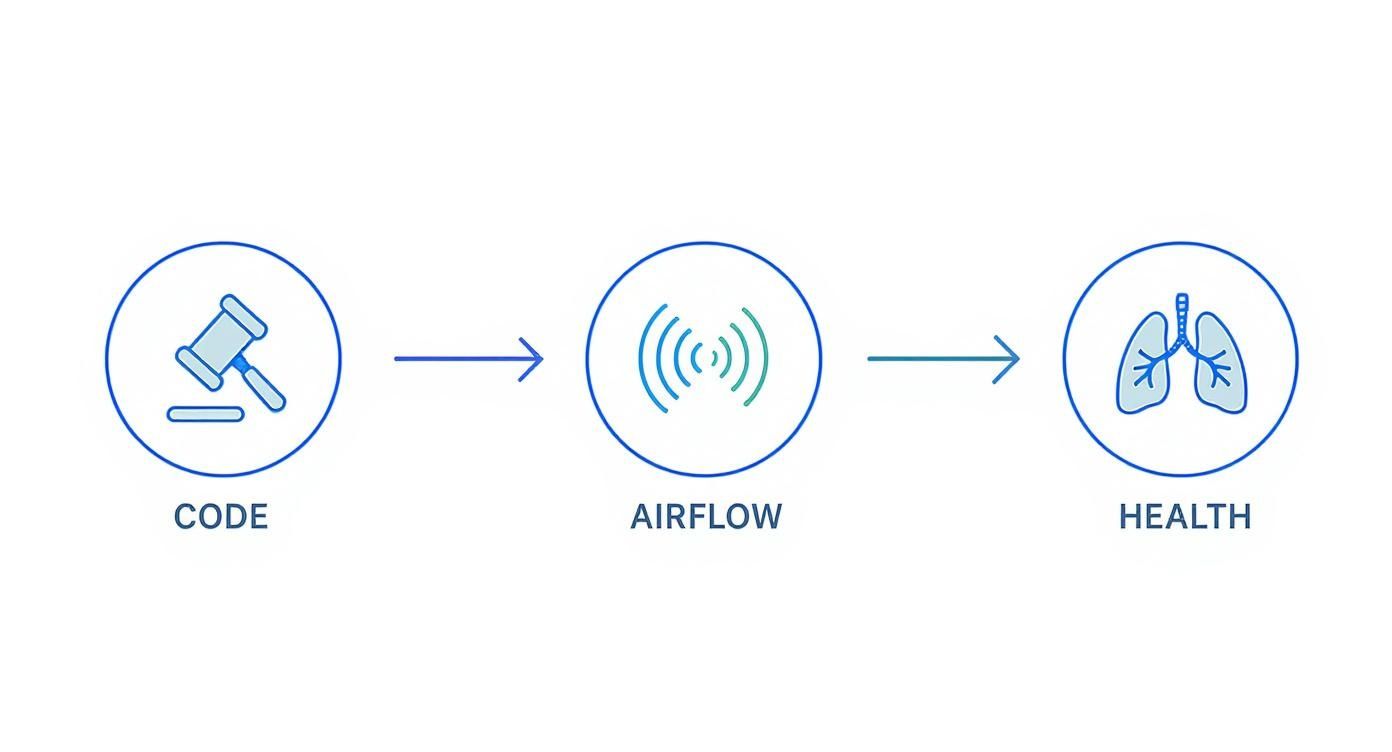
The visual makes it clear: following the code isn't just about compliance. It's a direct pathway to achieving the right airflow for a healthier indoor environment.
A Simple Calculation Example
Let's put the ACH method into practice with a real world example. It’s much simpler than it sounds.
First, you need the volume of your bathroom. Just multiply its length, width, and height.
Room Volume (m³) = Length (m) x Width (m) x Height (m)
Let's imagine a commercial bathroom that is 4 metres long, 3 metres wide, and 2.5 metres high.
4m x 3m x 2.5m = 30 cubic metres (m³)
Easy enough, right? Now, we bring in our target of 10 air changes per hour. To work out the total airflow needed for the hour, you just multiply the room's volume by the ACH target.
30 m³ x 10 ACH = 300 m³ per hour
But ventilation fans are measured in litres per second (L/s), not cubic metres per hour. So, we have one last conversion to do. To determine the appropriate ventilation for your bathroom, you'll need to understand key metrics like airflow, and it's helpful to know how to accurately calculate air changes per hour for different scenarios.
To get to L/s, you multiply the cubic metres per hour by 1000 (to get litres) and then divide by 3600 (the number of seconds in an hour).
Required Airflow = (300 x 1000) / 3600 = 83.3 L/s
So, for this specific bathroom, you'd need an exhaust system capable of moving at least 83.3 L/s to meet the 10 ACH target.
This simple skill gives you the confidence to assess any existing system or specify a new one correctly. You're no longer just looking at a fan in a box; you're looking at its actual performance capability.
Sample Airflow Calculation for Commercial Bathrooms
To make this even clearer, here are a few simplified examples. The table below shows the minimum required airflow for different sized commercial bathrooms, based on the Australian Standard target of 10 air changes per hour (ACH).
| Room Dimensions (L x W x H) | Room Volume (m³) | Required Airflow Rate (Litres per second, L/s) |
|---|---|---|
| 2.5m x 2m x 2.4m | 12 m³ | 33.3 L/s |
| 4m x 3m x 2.5m | 30 m³ | 83.3 L/s |
| 5m x 4m x 2.7m | 54 m³ | 150 L/s |
| 6m x 5m x 3m | 90 m³ | 250 L/s |
As you can see, the required airflow scales up significantly with room size. A larger, high traffic facility needs a far more powerful system than a small office washroom to achieve the same level of air quality.
Choosing the Right Ventilation System
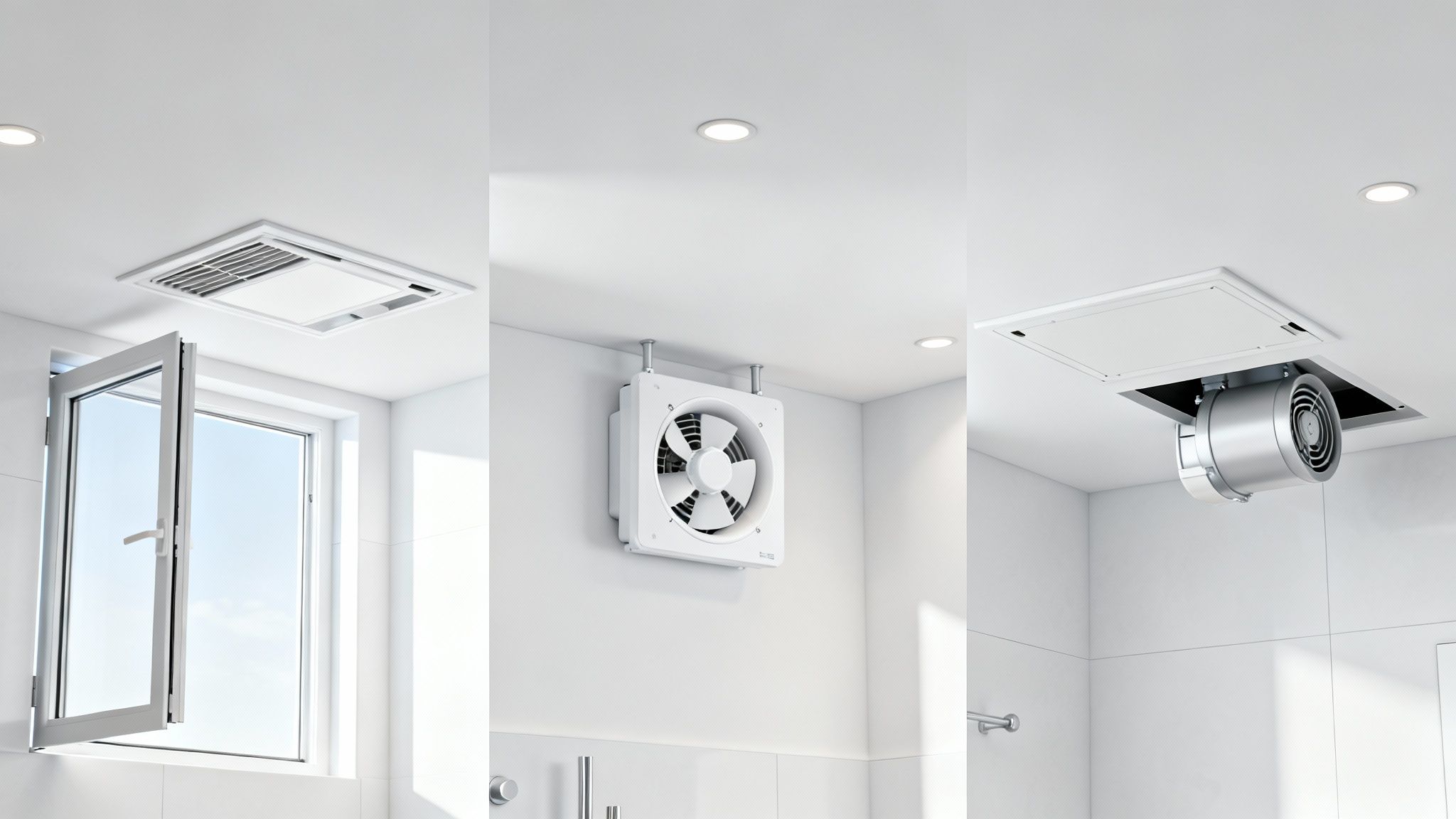
Okay, you’re convinced you need proper ventilation. Great! But now you're standing in front of a wall of options, and it all starts to feel a bit complicated.
Which type of system is the right tool for your specific job? It’s not as tricky as it seems. Let's break down the main players in the world of bathroom ventilation.
Think of it like choosing a vehicle. You wouldn't use a bicycle to move a piano, right? Same principle. We need to match the technology to the task at hand.
The Old School Method: Natural Ventilation
First up, we have the simplest solution of all: natural ventilation.
This is basically just opening a window or using a passive vent in the wall. It’s been the default method for generations, and in some very specific situations… it can still work. A small, rarely used bathroom with a large window in a breezy location might just get by.
But let’s be honest, in the real world of modern buildings, it's just not reliable enough. What happens on a cold, rainy day when nobody wants to open the window? Or in a secure facility where windows must remain closed? It’s a solution that depends entirely on weather and human behaviour, which makes it a bit of a gamble.
For any commercial space or high traffic bathroom, relying solely on natural ventilation is like hoping it doesn't rain on your wedding day. You need a better plan.
Mechanical Systems: The Real Workhorses
This is where things get serious. Mechanical ventilation systems are the engines that power modern air quality. They don’t rely on the weather… they just get the job done.
Within this category, there are a few key types you'll come across, each with its own set of strengths and weaknesses.
It's crucial to understand that not all fans are created equal. The cheap, noisy fan you might find in a budget motel is worlds apart from the quiet, powerful systems designed for premium commercial spaces. The difference in performance, and long term reliability, is huge.
Let's compare the two most common types of mechanical exhaust fans.
1. Axial Exhaust Fans
These are the standard fans you see most often. Think of a propeller on a plane. An axial fan pulls air straight through and pushes it directly out. They’re great at moving a good volume of air over very short distances with little resistance.
- Best for: Simple, through the wall installations where there’s no ductwork involved.
- Downside: They lose power fast when they have to push air through long pipes or around bends. They can also be quite noisy.
2. Inline (Centrifugal) Fans
Now, these are the quiet achievers. An inline fan (also known as a centrifugal fan) is usually installed inside the ceiling cavity or roof space, away from the bathroom itself. It works more like a water wheel for air, using an impeller to draw air in and force it out at a 90 degree angle.
This design creates much higher pressure, giving it the muscle to push air through long and complicated duct runs without breaking a sweat.
- Best for: Almost any modern commercial application, especially in bathrooms that aren’t on an external wall.
- Upside: They are significantly quieter because the motor is located away from the room. They are also much more powerful and efficient at handling the resistance from ducting.
For any serious ventilation in bathroom projects, an inline fan is almost always the superior choice. It has the grunt needed to overcome the challenges of real world installations.
Adding Some Smarts to the System
Ventilation doesn't have to be a 'dumb' system that just runs on a switch. Today, we have smart controls that can make your system more effective and efficient. It’s like giving your ventilation system a brain.
These systems use sensors to activate the fan automatically, exactly when it’s needed.
- Humidity Sensors (Humidistats): This is brilliant. A sensor detects when the humidity in the room rises above a set level, like when someone starts a shower, and automatically turns the fan on. It then runs until the humidity drops back to normal. No more forgetting to turn the fan on or leaving it running for hours.
- Occupancy/Motion Sensors: Common in commercial settings, these sensors activate the fan when someone enters the bathroom and turn it off after they leave (often with a pre-set run on timer). It’s a simple way to ensure ventilation while saving energy.
- CO₂ and VOC Sensors: In very high traffic or enclosed public restrooms, you might even see systems with sensors that detect levels of carbon dioxide (CO₂) or volatile organic compounds (VOCs). These are excellent for managing general air quality and odour control on demand.
Choosing the right system comes down to understanding the specific demands of your space. Is it a small ensuite or a sprawling public facility? By matching the technology to the need, you ensure your investment delivers fresh air, a healthy environment, and long term protection for your building.
Installation Mistakes That Undermine Performance

This is where even the best laid plans can go horribly wrong. You can spend good money on the most powerful fan on the market, but a poor installation will absolutely cripple its performance.
It’s like owning a race car but only ever driving it in school zones. The power is there, but you can’t actually use it. When it comes to effective ventilation in bathroom spaces, the installation is just as critical as the fan itself.
The unsung hero of any great installation is the ducting. It’s the part you don’t see, hidden away in the ceiling cavity, but it’s what makes the entire system work.
The Problem with Flimsy Ducting
Let's talk about the ducting itself. You've probably seen that cheap, flimsy, flexible silver tubing that looks a bit like a Slinky. Installers sometimes love it because it's easy to scrunch up and jam into tight spaces.
But for airflow? It’s terrible.
The ribbed design creates a huge amount of friction and turbulence, slowing the air right down. Worse still, it's easily crushed, kinked, or sagged during installation, creating bottlenecks that literally choke the fan. A single tight bend or a squashed section can cut your fan's extraction power by half.
The gold standard is smooth, rigid ducting. Think of it like a waterslide versus a rocky creek bed. Air flows effortlessly through a smooth pipe, but it has to fight its way through a corrugated one. That smooth path allows your fan to work at its peak efficiency, moving the maximum amount of air with the least amount of effort and noise.
The Shortest Path is the Best Path
Even with the best ducting, the layout is everything. Every single bend, twist, or extra metre of length adds resistance, forcing the fan to work harder just to push the air out.
The goal should always be to create the shortest, straightest path possible from the fan to the outside world. This isn't just a suggestion… it’s a fundamental principle of good ventilation design.
Think about it… would you rather run a 100 metre sprint on a straight track or one with five sharp U turns? The fan feels the same way. A convoluted duct run dramatically reduces airflow, leaving moisture and stale air trapped in the bathroom. It’s a common shortcut that leads to long term problems.
Never Vent Into the Roof Cavity
This is the big one. This mistake is so common, yet so incredibly destructive. You must never, ever vent a bathroom fan into the roof cavity or attic space.
Dumping litres of warm, humid air into an enclosed, unventilated space is like setting up a five star resort for mould. You are literally creating the perfect dark, damp environment for it to thrive. This can lead to rotting timber, damaged insulation, and a serious mould problem that can spread through the entire building. If you're already noticing signs, you might want to learn more about tackling mould in the bathroom ceiling and what causes it.
All ventilation must terminate outside the building. No exceptions. This means running the ductwork to an external wall vent or through the roof to a proper weather proof cowl. This commitment to proper exhausting isn’t new… regulators have understood its importance for decades. In Western Australia, for example, the old Sewerage (Lighting, Ventilation and Construction) Regulations 1971 were incredibly strict, mandating specific duct sizes and shaft dimensions to ensure air was properly removed from buildings. You can discover more about these historical public health regulations and why they were so focused on airflow.
Getting the installation right from the start ensures the system you invested in actually does the job you paid it to do. Don’t let a few simple, avoidable mistakes turn your powerful ventilation system into a useless ornament.
Simple Maintenance and When to Call a Pro
Just like any hard working machine, your bathroom ventilation system needs a little attention to keep it running smoothly. The good news? The basic upkeep is surprisingly simple.
You don’t need to be a technician to make a huge difference to its performance and lifespan. It’s mostly about keeping things clean and clear of blockages.
Think of it like servicing your car versus neglecting it for years. A little bit of care goes a very long way in stopping bigger, more expensive problems from showing up down the track.
Your Simple Maintenance Checklist
Running through these quick steps every six months or so can keep your system breathing easy and protect your bathroom from moisture build up. It's especially important in high traffic facilities.
- Clean the Fan Grille: Dust and lint love to clog up the intake grille. Just wipe it down with a damp cloth or use a vacuum with a brush attachment to clear away any gunk.
- Check the External Vent: Head outside and make sure nothing is blocking the external vent flap. Things like spiderwebs, leaves, or even a bird's nest can stop the flap from opening, trapping all that moist air right where you don't want it.
- Listen for Strange Noises: When the fan is running, does it sound smooth? Or is it making a grinding, rattling, or unusually loud noise? A change in sound is often the first sign that something isn’t right.
For a deeper dive, this article explains in detail why you should always clean your bathroom exhaust fan and the benefits it brings to your bathroom's health.
Knowing When to Call for Backup
While regular cleaning is fantastic, we also have to be realistic about when a problem is beyond a simple DIY fix. Ignoring the warning signs is a recipe for disaster.
Spotting a problem early is the key. A lingering damp smell or mould that keeps returning aren't issues you can just wipe away. They are symptoms of a bigger failure in your ventilation system that needs expert attention.
So, when is it time to pick up the phone?
- Mould That Won't Quit: If you’ve scrubbed away mould only for it to reappear in the same spot, that's a huge red flag. It means the root cause, excess moisture, is not being dealt with. To get on top of the issue before it spreads, it's worth reading up on how to prevent mold in your bathroom with effective strategies.
- The Fan Has No Power: You can hear the motor running, but it doesn't seem to be pulling any air. An easy test is to hold a single square of toilet paper up to the grille… if the fan doesn't hold it firmly in place, it has lost its pull.
- Visible Water Stains or Dripping: If you see water stains on the ceiling around the fan or notice actual dripping, call a professional immediately. This could point to a serious condensation issue inside the ducting or even a leak from where the vent penetrates the roof.
Knowing the difference between simple maintenance and a job for a pro is crucial. It protects your property, ensures the effectiveness of your ventilation in bathroom spaces, and safeguards the health of everyone who uses the facility.
Your Bathroom Ventilation Questions Answered
We get a lot of questions about getting bathroom ventilation right, especially in busy commercial spaces. So, we've put together the most common ones we hear from facility managers and business owners. Think of it as a quick cheat sheet for those nagging queries.
Let's clear the air on everything from how long to run your fan to what type of system you actually need.
How Long Should an Exhaust Fan Run After a Shower?
This is a great question and one that's often overlooked. You need to give the fan enough time to pull all that heavy, humid air out completely. A solid rule of thumb is to let it run for at least 20 to 30 minutes after the water is turned off.
This ensures it captures all the lingering moisture that would otherwise settle on cool surfaces like walls and ceilings, eventually leading to mould. If your fan is wired to the light switch, it's worth getting a separate timer installed. That way, you can just set it and forget it, knowing it'll do its job properly and then switch off automatically.
Can I Vent a Bathroom Fan Into the Roof Space?
Absolutely not. Venting warm, moist air directly into a ceiling cavity or attic is one of the most destructive mistakes we come across.
It’s like creating a perfect little incubator for mould, mildew, and wood rot. Over time, this will cause serious structural damage and ruin the indoor air quality for the entire building. All ventilation must be ducted to the outside air. There are no shortcuts here… the risk of damage just isn't worth it.
The difference between an axial and a centrifugal fan is like the difference between a desk fan and a jet engine. One is great for moving air in an open space, while the other is built to create serious pressure and force air through a specific channel.
What Is the Difference Between Axial and Centrifugal Fans?
Let's break it down with a simple analogy.
An axial fan works like a propeller. It’s brilliant at moving large volumes of air over a short distance where there's little resistance. These are the fans you'll typically see in simple through the wall installations that don't require any ductwork.
A centrifugal fan, on the other hand, is more like a water wheel for air. It uses a spinning impeller to suck air in and then force it out at a 90 degree angle. This design creates much higher pressure, making it the clear winner for pushing air through long or complex ducting systems.
Even with the best fan, stubborn mould can sometimes take hold in tricky spots like silicone seals. If that happens, our guide on how to remove mould from silicone offers some practical steps.
At That Cleaning Crew, we understand the challenges of maintaining a healthy, mould free commercial environment. If you're facing persistent moisture issues, our professional mould remediation services can identify the source and provide a lasting solution. Get a free on-site quote today.


