As a facility manager, you're not just looking after a building. You're the custodian of a major asset, a workplace for hundreds of people, and a prominent feature of the Sydney skyline. You know better than anyone that the state of your building’s windows is about so much more than just clean glass.
It's the first impression you make on every visitor. It’s a direct reflection of the high standards you work so hard to uphold day in and day out.
But tackling the windows on a high-rise isn't exactly a weekend job with a squeegee and a bucket. It’s a major operation with seriously high stakes.
You’re constantly juggling competing priorities. Budgets need to be met, safety regulations must be followed to the letter, and the work needs to be done flawlessly… all without causing chaos for the tenants and visitors inside. It’s a heavy lift.
Your No-Nonsense Guide to High-Rise Window Cleaning
This guide is designed to cut through the industry noise. We’re going to break down everything you need to know about professional high-rise window cleaning, with a specific focus on the unique challenges and requirements right here in Sydney.
We’ll walk you through:
- The Methods: How do the pros actually get up there? We'll look at the different techniques, from abseiling down the facade to using permanent building cradles.
- The Safety Lingo: What do terms like 'SWMS' and 'IRATA certification' actually mean for you and your legal responsibilities?
- Finding the Right Partner: How can you choose a team you genuinely trust to get the job done right, safely, and on schedule?
Think of this as your practical playbook. It’s not about drowning you in technical jargon. It’s about giving you the confidence to make the best decisions for your building.
Our goal is to give you clear, straightforward advice. The kind of information that helps you tick this massive job off your to-do list, knowing it’s been handled by true professionals. We want to help you keep your building looking its absolute best, protecting its value and ensuring it stands out for all the right reasons.
Let's dive in.
The High-Flying Toolkit for Cleaning Skyscraper Windows
Ever look up at a cleaner dangling from a skyscraper and just… wonder? It looks like a scene out of a spy movie, but it's all down to a highly specialised set of tools and techniques designed to tackle impossible heights. There's no single magic trick. Instead, it’s about picking the right tool for the right job, especially across Sydney's diverse skyline.
Let’s pull back the curtain on how it’s actually done. There are a few key methods you'll see in action, and each has its place.
When Buildings Get Complicated Rope Access Is Key
First up, there's Rope Access, which you might know as industrial abseiling. Think of it like professional rock climbing… but for buildings. Our highly trained technicians use ropes, harnesses, and specialised gear to descend a building's facade, giving them complete control over where they go. It's incredibly versatile.
This method is perfect for those stunning modern architectural designs with tricky angles, curves, or overhangs. If a building isn't a simple, flat glass box, rope access gives technicians the agility to navigate every hard-to-reach corner safely and meticulously. It's precise, efficient, and has a minimal footprint on the ground. A huge plus in busy CBD areas where you can't just block off a street.
The Classic Approach Cradles and BMUs
Then you have the classic method you've probably seen a hundred times: Building Maintenance Units (BMUs), or cradles. These are the permanent rigs you see gliding smoothly up and down the sides of glass towers. The true workhorses of high-rise window cleaning.
For many newer skyscrapers, BMUs are designed right into the building's structure from day one. They run on a track system installed on the roof, providing a stable and secure platform for our cleaners. This setup is ideal for regular, scheduled cleaning on large, uniform facades. It’s a reliable and incredibly efficient way to maintain a building's pristine appearance year-round.
Understanding when professional help is a non-negotiable is the first step. This simple decision tree shows why high-stakes buildings need a professional touch.
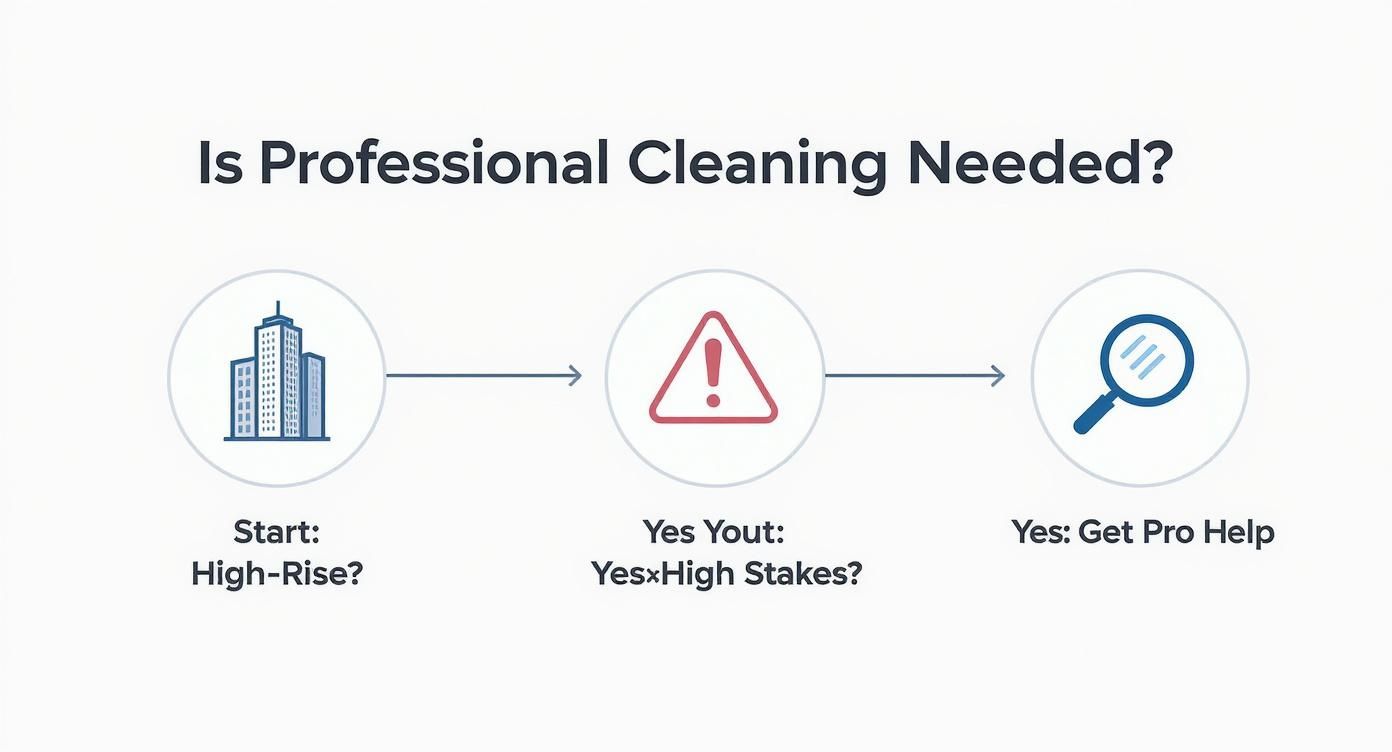
The takeaway here is clear: when you're dealing with height, the risks multiply, making professional expertise absolutely essential.
Options for Mid-Rise and Accessible Buildings
Of course, not every building in Sydney is a super-tall skyscraper. For those that aren't quite touching the clouds, there are other brilliant tools in the kit.
Elevated Work Platforms (you’ve probably called them cherry pickers) are fantastic for reaching mid-level heights. They offer a secure basket for technicians and can be moved around the base of a building with relative ease, making them a great solution for buildings where ground access is straightforward.
And for the lower levels, technology has come a long way. Advanced Water-Fed Poles can now reach impressive heights, sometimes up to five or six storeys, all from the safety of the ground. These systems use purified water that leaves a perfect, streak-free finish without any detergents. It's a safe and eco-friendly option. It's an incredibly effective method that's part of a wider approach to specialty cleaning solutions.
To help you see how these methods stack up, here's a quick comparison.
Quick Comparison of High-Rise Cleaning Methods
| Access Method | Best For | Typical Height Range |
|---|---|---|
| Rope Access/Abseiling | Complex architecture, hard-to-reach areas, minimal ground disruption. | Any height, especially 10+ storeys. |
| Building Maintenance Units (BMUs) | Large, uniform glass facades with existing track systems. | 15+ storeys. |
| Elevated Work Platforms (EWPs) | Mid-rise buildings with good ground access. | Up to ~15 storeys (approx. 45m). |
| Water-Fed Poles | Ground floors and lower levels, environmentally sensitive cleaning. | Up to 5-6 storeys (approx. 20m). |
Each method has its strengths. The best choice always depends on the unique features of your building.
Choosing the right method isn't just about height. It's a calculation involving your building's architecture, ground-level accessibility, the level of grime, and your budget. A great cleaning partner will assess all these factors to recommend the safest and most effective approach.
It's a huge part of the economy, too. The commercial window cleaning market is a key player in Australia's broader $14 billion commercial cleaning industry. In fact, exterior window cleaning is the third-highest revenue generator in the entire sector, showing just how critical these professional services are for maintaining our city's infrastructure.
Safety First Always Without Compromise
Let's get straight to the most important thing. The absolute non-negotiable. When you have people working hundreds of metres in the air, hanging off the side of your building, safety isn't just a priority… it's everything.
As a facility manager, this is probably your biggest concern. And for good reason. The responsibility is huge. So, how can you be certain the team you hire for your high-rise window cleaning isn't just good at their job, but obsessed with doing it safely?
You need to know what to look for. It’s about more than just a vague promise to "be careful".
The Paperwork That Actually Matters
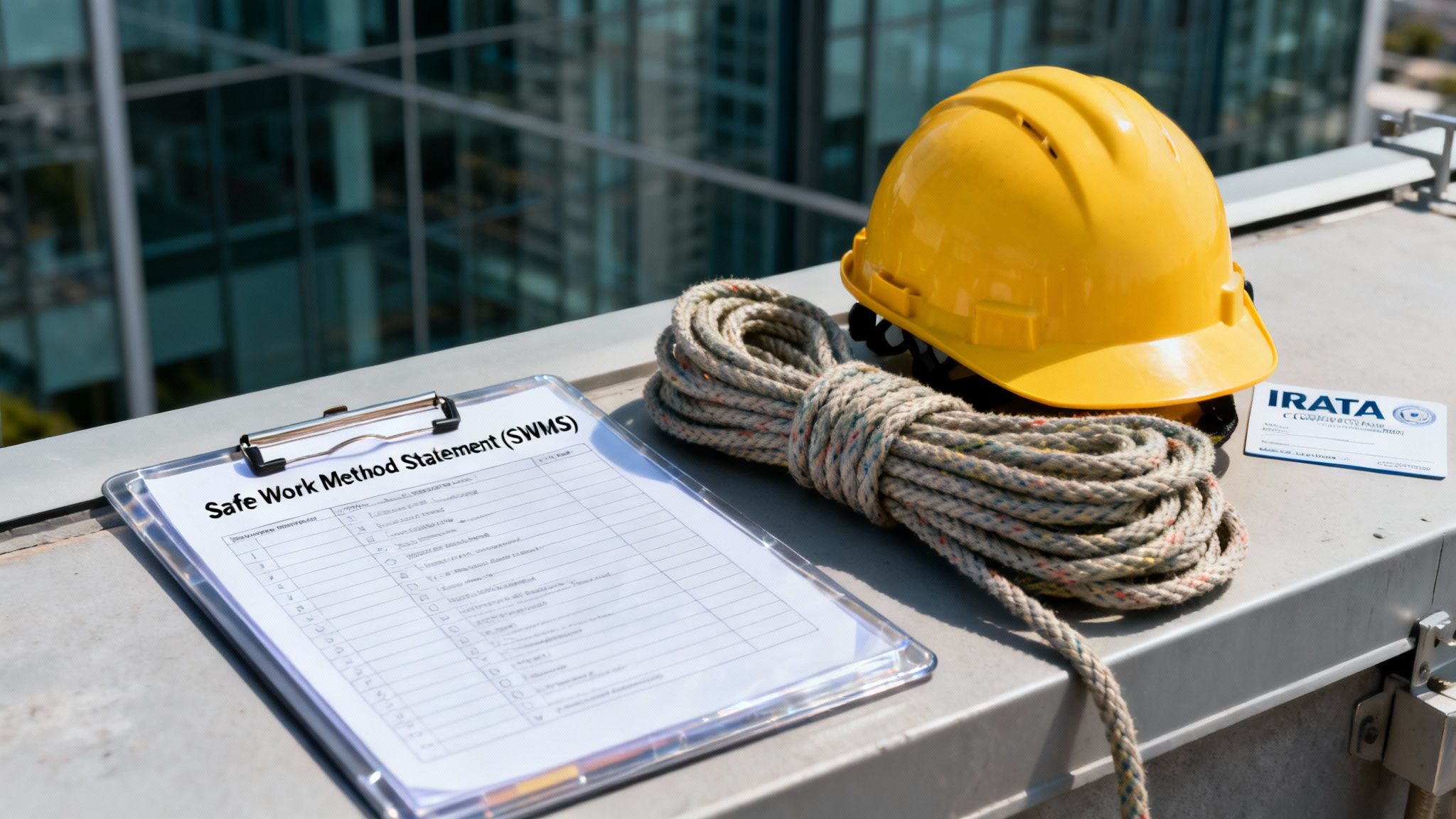
Let's start with the documentation. I know, I know… paperwork. But in this game, the paperwork is the proof. The first thing you should always ask to see is a Safe Work Method Statement, or SWMS (often pronounced 'swims').
Think of a SWMS as the detailed game plan for the entire job, from the moment the team arrives on-site to the second they leave. It identifies every single potential risk. High winds? That's in there. Pedestrians below? Covered. Equipment checks? Absolutely.
It then outlines the step-by-step procedures to eliminate or control those risks. A generic, one-page document won't cut it. You want to see a detailed, site-specific SWMS that has clearly been created for your building. This shows a company that does its homework and takes its responsibilities, and your building's safety, seriously.
A SWMS isn't just a formality. It’s a legal requirement under Work Health and Safety (WHS) regulations in Australia for any high-risk construction work. And believe me, working at height definitely qualifies. It’s a clear signal that the company operates by the book.
Certifications The Mark of a True Professional
Next up are the certifications. These aren't just nice-to-haves. They are essential qualifications that prove a technician has undergone rigorous, standardised training.
Here are the key ones to look for:
- IRATA or ARAA Certification: For any team using rope access (abseiling), this is the global gold standard. IRATA (Industrial Rope Access Trade Association) and ARAA (Australasian Rope Access Association) certifications mean the technicians have been trained and assessed on everything from rescue procedures to complex rigging techniques. There are different levels, so you'll know you're getting experienced professionals.
- Working at Heights Ticket: This is a fundamental certification for anyone working where there is a risk of a fall. It covers the correct use of safety harnesses, anchor points, and fall arrest systems.
- EWP Licence: If the job involves an Elevated Work Platform (like a cherry picker), the operator must hold the appropriate high-risk work licence.
Given the inherent risks of working at extreme elevations, an Essential Safety Guide for Confined Space and Working at Heights is indispensable for maintaining rigorous safety protocols. A professional team lives and breathes these principles every single day.
Insurance The Ultimate Safety Net
Finally, let's talk about insurance. If a contractor can't immediately provide you with a Certificate of Currency for their insurance, that's a massive red flag. You're looking for two key things here.
First is Public Liability insurance. This protects against injury to people or damage to property. For high-rise work, you should expect to see coverage of at least $20 million. It sounds like a lot, but when you're dealing with multi-million dollar buildings and the safety of the public, it's the responsible level of cover.
Second is Workers Compensation insurance. This is mandatory and ensures that the cleaning company's employees are covered if they are injured on the job. It’s about protecting the technicians and protecting you from any liability.
Ultimately, this all comes down to trust. You need to trust that the team you hire isn't just great at cleaning windows. You need to know, without a shadow of a doubt, that they are meticulous professionals who put safety first, always, without a single compromise.
Budgeting for Window Cleaning Costs and Frequency
This is the big question, isn't it? Let’s get into the nuts and bolts of what it actually costs to keep a high-rise sparkling. The truth is, there's no simple, one-size-fits-all price tag for high-rise window cleaning. It's a bit like asking "how much is a car?"… it really depends on the model.
The final quote you receive will be a blend of a few key ingredients. Your building is unique, and its cleaning plan should be too.
What Shapes the Final Quote
First and foremost is the sheer size and height of your building. More glass means more time and more resources, plain and simple. A 60-storey skyscraper in the CBD will naturally be a bigger investment than a 15-storey apartment block in the suburbs.
But it’s not just about size. The complexity of your building’s design plays a huge part. Is it a straightforward glass tower, or does it have lots of architectural features like balconies, overhangs, or decorative fins? Those tricky, hard-to-reach spots require more skill and time, which definitely influences the cost.
Then there's the access method required. As we've touched on, a job that can be done with a simple water-fed pole from the ground is always going to be more budget-friendly than a full abseiling team needing to rig ropes from the rooftop. If you want to dive deeper into the specifics, we've put together a detailed guide exploring Sydney window cleaning service costs.
Finding Your Cleaning Rhythm
So, how often should you be getting this done? Again, it depends. There’s no single right answer, but it comes down to finding that perfect sweet spot between a gleaming facade and a happy budget.
Here are a few things that determine the right frequency for your property:
- Location, Location, Location: A landmark building right in the heart of Sydney, exposed to traffic pollution and salty sea air, might need a quarterly clean to stay looking sharp.
- Building Use: A high-end commercial tower with corporate tenants will likely have higher standards for appearance than a residential building a bit further from the city centre.
- Local Conditions: Weather plays a surprisingly big role. For instance, wind is a significant operational challenge in many Australian cities. These constraints mean schedules often fall into a regular rhythm.
For most commercial high-rise buildings in Sydney, a clean twice a year is a really solid benchmark. This schedule is frequent enough to prevent heavy build-up of dirt and grime, keeping the glass in great condition without overstretching the maintenance budget.
Some buildings might push to an annual clean, while others might need it every three months. It’s all about a custom fit. When considering ongoing expenses for high-rise buildings, exploring strategies for HOA Common Area Maintenance Tips for Communities can provide a broader perspective on managing these essential services effectively.
A good cleaning partner will work with you to figure out a schedule that makes sense for your specific building and your budget.
How to Choose Your High Rise Window Cleaning Partner
Hiring a team for high rise window cleaning feels a bit like choosing a specialist surgeon for a critical operation. It's not a decision you make lightly. You're looking for deep experience, a fantastic track record, and someone you can trust completely with one of your most valuable assets.
So, how do you sort the true professionals from the rest? It goes way beyond just asking, "how much?".
To make a truly informed decision, you need to dig a little deeper. The right partner will not only welcome your questions but will also have impressive answers ready to go. This is about finding a team that makes your life easier, not one that adds another layer of stress to your already packed schedule.
Look for Proof, Not Just Promises
A great company will be proud of their work and happy to show it off. Don't just take their word for it when they say they're experienced. Ask them for tangible proof that backs up their claims.
This is where you can really start to see the difference between providers.
- Ask for Case Studies: Request examples of buildings they've worked on that are similar to yours. A company that has cleaned a 40-storey glass tower in the Sydney CBD will understand the unique challenges of wind, traffic, and access in a way a suburban crew might not.
- Request Testimonials and References: Any reputable company should be able to provide testimonials from other facility managers. Better yet, ask if you can speak to one or two of their current clients. A quick chat with a peer can tell you everything you need to know about their reliability and professionalism.
This isn't about being difficult. It's about doing your due diligence. A true partner will understand and respect that completely.
The Questions That Reveal Everything
Once you've seen their track record, it's time to get into the specifics of how they operate. This is where you can assess their commitment to safety, quality, and reliability. Think of it as a checklist for peace of mind.
Here are the non-negotiable questions to ask:
- Can I see your safety records and certifications? This should be an easy 'yes'. They should be able to instantly provide you with their SWMS documentation, IRATA or ARAA certifications for their rope access team, and proof of all relevant licences.
- What is your insurance coverage? Ask for their Certificate of Currency for Public Liability (look for $20 million or more) and Workers Compensation. No certificate, no contract. It's that simple.
- Are your technicians full-time employees or subcontractors? This is a really telling question. A company that invests in its own full-time, highly trained team is demonstrating a long-term commitment to quality and consistency. It often leads to a more stable and reliable service for you.
- How do you manage communication and scheduling? You want a partner who is proactive. Ask about their process for scheduling, handling weather delays, and communicating with you and your tenants. A well-organised company will have a clear system in place.
Choosing a provider is the first step in what should be a long-term relationship. It's worth putting in the effort upfront to find a team that aligns with your standards and understands the importance of clear communication.
Making the right choice means you get more than just clean windows. You get reliability and the confidence that the job is being handled safely and professionally every single time. It's also why understanding the structure of your agreement is so important. When you're ready, learning more about how commercial cleaning contracts are structured can give you an even clearer picture of what to expect from a professional partnership.
The Highly Skilled People Behind the Ropes
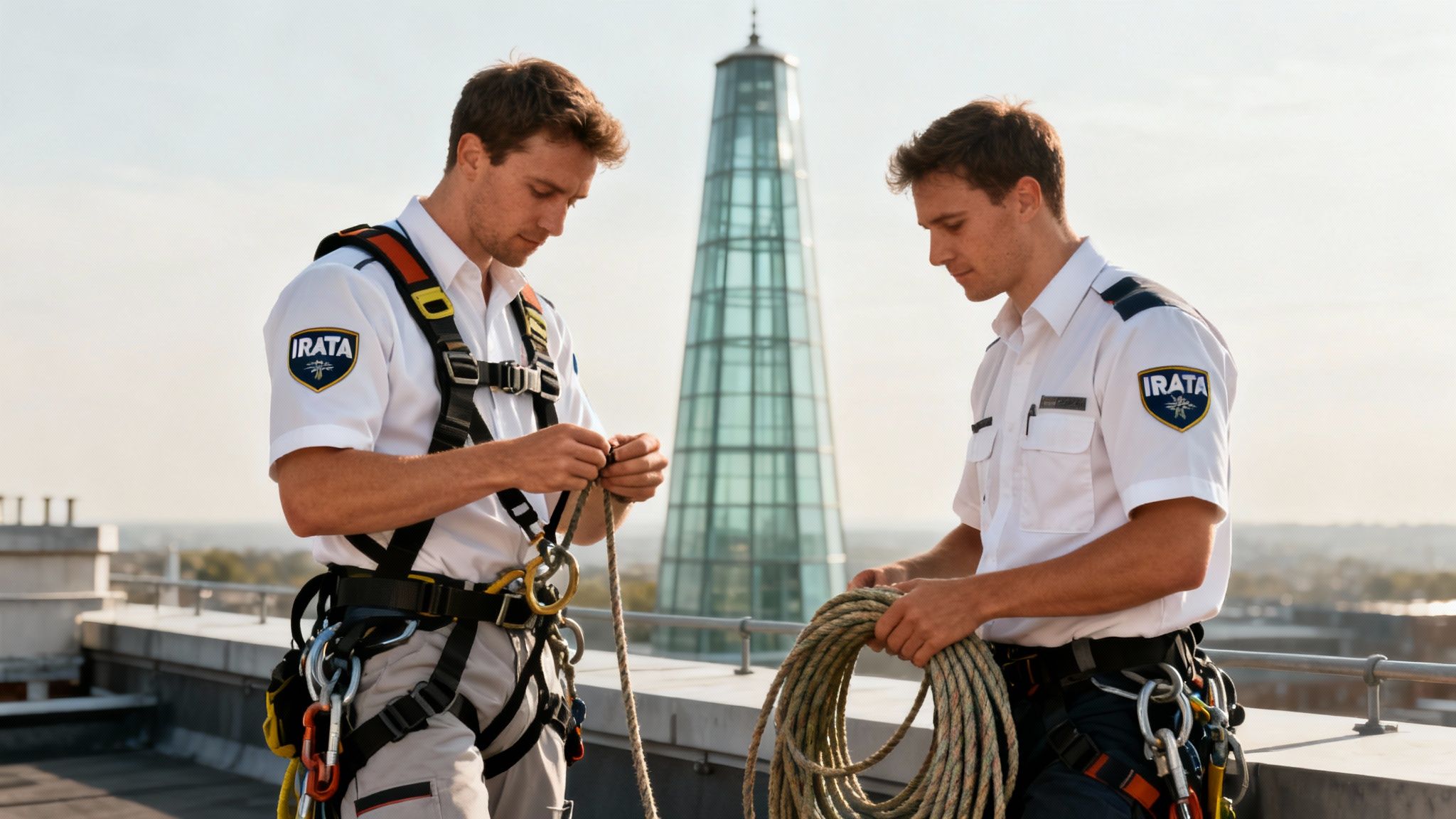
It’s easy to get caught up in the equipment. The ropes, the cradles, the impressive machinery. And fair enough, the gear is impressive. But the real heart of any high-rise window cleaning operation is the people. The incredibly skilled, surprisingly calm professionals doing this extraordinary work.
Let's be clear: this is not a job for just anyone. You can't just be "okay with heights." You need to be completely at home up there, with a unique mix of peak physical fitness, a meticulous eye for detail, and an exceptionally cool head when you’re hundreds of metres in the air.
These technicians are true professionals in a highly specialised trade.
More Than Just a Head for Heights
Becoming a rope access technician or a certified BMU operator doesn't happen overnight. It's a career path built on rigorous, hands-on training, a deep understanding of complex safety protocols, and a commitment to continuous learning and recertification.
Think of them as athletes who are also safety experts. Every single day, they need to master:
- Complex Rigging: Setting up safe and secure anchor systems on all kinds of different rooftops.
- Rescue Procedures: Knowing exactly what to do if something goes wrong, for themselves or a teammate.
- Equipment Mastery: Intimately understanding every single piece of their gear, from carabiners to descenders.
This is exactly why choosing a reputable company that invests in its people is so critical. You're not just hiring a cleaning service. You’re bringing in a team of specialists you can trust with your most valuable asset… not to mention the safety of everyone in and around your building.
It’s a profession where there are absolutely no shortcuts. The training is tough for a reason. Every day, these technicians put their trust in their equipment, their training, and each other.
A Specialised Trade with Fitting Rewards
In Australia, high-rise window cleaning is recognised for what it is. A highly demanding and skilled profession. It requires a level of expertise and nerve that sets it apart from other trades, and the pay reflects that reality.
This isn’t just a cleaning job. It’s a high-risk, high-skill career. The average wage for rope access technicians or BMU operators is around $28 per hour in Australia, which is notably higher than many related trades. It’s an acknowledgement of the extensive training and daily risks involved. You can see how this compares to other trade wages on when.com.au.
Understanding the calibre of the professionals behind the ropes helps put everything into perspective. It clarifies why investing in a well-supported, properly trained team isn't just a good idea—it's the only way to do it right.
Common Questions from Facility Managers
We get it. When you're responsible for a massive building, you've got questions. And you deserve straightforward, honest answers. We've gathered some of the most common things we hear from facility managers just like you.
How Do You Handle Bad Weather?
This is a big one, especially in a city like Sydney where the weather can turn on a dime. Safety is our absolute number one priority, so we’re constantly monitoring conditions like a pilot before takeoff.
Every professional high-rise window cleaning company has strict wind speed limits. If the gusts are too strong, we don't work. It's that simple. We will never operate in lightning storms or dangerously rainy conditions. It’s just not worth the risk.
If we do have to postpone a job, communication is key. We'll be on the phone with you immediately to find the next suitable day. For larger projects, we always build contingency days into our schedule because we know the weather isn't always on our side. This ensures we can still hit our deadlines without ever compromising on safety.
What Kind of Disruption Can Our Tenants Expect?
Your tenants' experience is incredibly important, and the last thing you need are complaints. Our goal is to be like ghosts… you know we were there because the windows are sparkling, but you barely noticed us at the time.
We work hard to keep disruption to an absolute minimum. A great team coordinates closely with you to plan the work for low-traffic times. We'll always ensure any work areas on the ground are safely cordoned off to protect pedestrians and building occupants.
For the tenants inside, they might see our technicians briefly outside their window, but our teams are professional, discreet, and focused on their work. A little bit of clear communication with tenants beforehand—which we can help you with—usually ensures everything runs smoothly.
A professional crew understands they are guests at your property. Their job is to enhance the building, not to interfere with the people who work or live inside it.
Are Your Cleaning Products Environmentally Friendly?
That's a fantastic and increasingly important question. The short answer is yes, absolutely. Most professional companies now prioritise using environmentally friendly and biodegradable cleaning solutions. We all share this city, and protecting its environment matters.
Even better, in many cases, especially with modern water-fed pole systems, we can achieve a perfect, streak-free clean using only highly purified water.
This method is brilliant because it leaves zero residue behind and is completely harmless to:
- The environment and local waterways.
- Your building's facade and surrounding landscapes.
- The health of your tenants and our team.
Do We Need to Prepare the Building Before You Arrive?
Generally, you don't need to do much at all! The most helpful thing you can do is ensure our team has clear access to the required areas, like anchor points on the roof or water sources on the ground level.
Before we even start, we'll have already done a full site inspection. From that, we'll give you a simple, clear checklist of anything specific we might need. Honestly, the biggest preparation step is simply communicating the schedule to your tenants, which is a key part of the smooth partnership we aim for.
Ready to see the difference a truly professional and reliable partner can make for your building? The team at That Cleaning Crew has the experience and safety-first approach to keep your property looking its best. Get in touch for a free, no-obligation on-site quote today.