Okay, let's talk about preventing cross-contamination. It all comes down to one really simple idea: keeping raw and ready-to-eat foods completely separate. That’s it. That’s the whole game. Every single step of the way, from storage to prep to serving, these two categories just shouldn't meet. Ever. This means having dedicated utensils, different chopping boards, and separate storage spots, all backed up by rock-solid handwashing and cleaning routines.
Think of it like creating little, unbreakable barriers to stop nasty germs in their tracks. Simple.
Why Preventing Cross-Contamination Matters
Before we get into the nuts and bolts, let's talk about the 'why'. Honestly, this is about so much more than just ticking boxes for a health inspector. It's about protecting people.
Your customers, your team, and the reputation you've worked so hard to build all depend on it.

Picture a tiny, unseen microbe hitching a ride from a raw chicken fillet to a fresh, ready-to-eat salad. That single moment of contact is all it takes. Seriously. The consequences can be devastating, and it’s a scenario that plays out in commercial kitchens far too often.
The Unseen Dangers in Your Workspace
When we talk about cross-contamination, we're usually dealing with two main culprits:
- Pathogens: These are the nasty bacteria and viruses that cause food poisoning. Think Salmonella, Campylobacter, and E.coli. They're invisible travellers, easily moving from raw meat, poultry, and fish onto surfaces, hands, and other foods.
- Allergens: These are proteins from foods like peanuts, dairy, gluten, or shellfish that can cause severe, sometimes life-threatening, reactions. For someone with a serious allergy, even a microscopic trace can be incredibly dangerous.
The scary part is that these contaminants don't move on their own. They're given a helping hand. A knife used on raw chicken and then to slice a tomato. An unwashed hand that preps a steak and then grabs a handful of salad greens. It’s these small, seemingly minor oversights that create the biggest risks.
A proactive approach to hygiene isn't just a compliance task; it’s the best defence your business has. It protects public health, builds customer trust, and safeguards the long-term health of your entire operation.
Common Contamination Hotspots and Quick Fixes
I've seen these same mistakes happen in countless businesses. So here’s a quick rundown of the most common hotspots and the immediate actions you can take to shut them down.
| Hotspot Area | The Risk | Your Quick Fix |
|---|---|---|
| Chopping Boards | Using the same board for raw meat and then vegetables. | Implement a strict colour-coded board system (e.g., red for meat, green for veggies). |
| Utensils | Tongs, knives, or spoons used for raw and then cooked/ready-to-eat foods without washing. | Have separate, clearly marked utensil containers for raw and cooked food prep areas. |
| Staff Hands | The number one vehicle for germs. Touching raw food then a door handle or another food item. | Rigorous, mandatory handwashing protocol with soap and water after handling any raw product. |
| Cleaning Cloths | A damp cloth used to wipe a raw meat spill then used on a food prep counter. | Use disposable paper towels for raw meat spills. Have colour-coded cloths for different zones. |
| Fridge Storage | Raw meat juices dripping from a top shelf onto ready-to-eat items below. | Always store raw meat, poultry, and fish on the bottom shelf of the fridge in sealed containers. |
These simple changes can make a massive difference right away. It's about building habits that become second nature to your team.
The Real-World Impact of a Small Mistake
The statistics paint a pretty sobering picture. Food poisoning is a major public health issue in Australia, and cross-contamination is a well-known cause.
Annually, there are an estimated 4.68 million cases of food poisoning across the country. This leads to nearly 48,000 hospitalisations and, tragically, 38 deaths. You can find more details on these food poisoning statistics directly from the NSW Food Authority.
This isn't just about numbers, though. It's about real people getting seriously ill. For any business, a single outbreak can lead to reputational ruin, legal action, and huge financial losses.
But a strong hygiene framework, built around preventing cross-contamination, turns this risk into a strength. It’s a non-negotiable part of a professional operation, just like understanding the fundamentals of what commercial cleaning actually involves. It’s about creating a safe, trustworthy environment from the ground up.
Conducting a Practical Risk Assessment
So, you’re ready to get serious about cross-contamination. Fantastic. But where on earth do you begin? It all starts with a solid, practical risk assessment.
Don't let the term scare you off… it’s not as bureaucratic as it sounds. Think of it as putting on a pair of detective glasses and looking at your own workspace with a completely fresh perspective. Your mission is to uncover all the secret pathways contaminants could take to get from A to B.
Seeing Your Space with Fresh Eyes
Your first job is to walk the entire journey of your products and ingredients. And I mean everything. From the moment that box of supplies arrives at your loading dock, through the prep station, onto the cooking line, and all the way to the final product landing in your customer's hands.
This isn’t about finding fault or pointing fingers. It’s about being genuinely curious. You're simply mapping out every single touchpoint where something could potentially go wrong. It’s a proactive step that puts you firmly in control, rather than just reacting when a problem inevitably pops up.
You’re looking for those tiny, almost invisible moments of risk.
- Take a look in the coolroom. Where is the raw meat stored? Is it safely tucked away on the bottom shelf, or is it lurking above ready-to-eat salads?
- What’s the procedure when a team member handles a delivery? Do they wash their hands thoroughly before moving on to food preparation?
- Think about allergens. How are your gluten-free ingredients really kept separate from regular flour during the chaos of a busy service?
These are the exact kinds of specific, nitty-gritty questions you need to be asking. It's all about finding those potential crossover points.
Identifying and Grading Your Hazards
Once you start looking, you'll begin to see potential hazards everywhere, and it’s easy to feel overwhelmed. The trick isn't just to list them, but to understand which ones pose the biggest threat.
Start by grouping the hazards you find into three main types:
- Microbial Hazards: This is your nasty bacteria and viruses. Think Salmonella from raw chicken or E. coli from unwashed vegetables.
- Allergenic Hazards: These are the big ones… peanuts, dairy, gluten, shellfish… that can cause severe, sometimes life-threatening, reactions.
- Physical Hazards: We're talking about things that shouldn't be there, like broken glass, tiny metal shavings, or even a stray hair finding its way into a dish.
The data shows just how critical this is. Cross-contamination is a massive driver of food recalls here in Australia. Between 2013 and 2022, there were 540 recalls linked to these very issues, with undeclared allergens being the biggest culprit by a long shot.
A risk assessment isn’t a one-time, tick-a-box exercise. It's a living document. It should be the foundation of your entire food safety plan, helping you focus your time, money, and training where it will have the biggest impact.
Putting It All on Paper
Okay, let's get practical. You don't need fancy software for this. A simple spreadsheet or even a dedicated notebook will do the job perfectly.
Create a simple table with three columns:
| Potential Hazard | Risk Level (Low, Medium, High) | How We'll Control It |
|---|---|---|
| Raw chicken juices dripping onto fresh lettuce in the fridge. | High | All raw meat must be stored in sealed containers on the bottom shelf. Staff retrained on storage. |
| Staff using the same tongs for raw and cooked sausages at a BBQ. | High | Use colour-coded tongs (red for raw, black for cooked). Provide separate containers for each set. |
| Flour dust from baking settling on a gluten-free prep surface. | Medium | Designate a separate, screened-off area for all gluten-free prep. Clean and sanitise before use. |
This simple exercise is incredibly powerful. It forces you to think through each problem and come up with a concrete, actionable solution.
By mapping it all out, you create a clear plan of attack. It helps you triage, deciding what needs your immediate attention… like the high-risk stuff… and what can be scheduled for later. For a more structured approach, our comprehensive commercial cleaning checklist can give you a brilliant starting point for documenting these essential daily and weekly tasks.
Going through this process gives you clarity. It moves you from worrying about vague 'what-ifs' to having a clear, actionable strategy to stop cross-contamination before it ever gets a chance to happen.
Right, you’ve done the detective work and figured out where your biggest risks are hiding. Now for the fun part: redesigning your space and processes to build in invisible barriers that stop contamination in its tracks.
Think of it like setting up traffic rules for your workspace. You wouldn’t want cars driving on the wrong side of the road, would you? It’s the same idea here. We need to create clear, one-way streets for staff, equipment, and ingredients to follow, making sure high-risk items never cross paths with low-risk ones.
Creating Clear Zones in Your Workspace
One of the most powerful concepts you can implement is zoning. It’s simply about physically or visually dividing your workspace into distinct areas for different tasks. You're creating dedicated zones for 'dirty' jobs and completely separate zones for 'clean' ones.
In a commercial kitchen, this is a non-negotiable. It might look something like this:
- Raw Preparation Zone: This area is strictly for raw meats, poultry, and fish. It’s the high-risk hot spot.
- Cooked/Ready-to-Eat Zone: This is where you handle foods that won't be cooked further, like slicing cooked meats, assembling salads, or plating desserts. Consider this your clean zone.
- Wash-Up Zone: Sinks and dishwashers need their own space to prevent dirty water from splashing onto clean surfaces and food.
These zones don't always need to be in separate rooms. You can create effective separation with physical barriers, like a stainless steel bench, or even by just dedicating specific benches to specific tasks. The key is being intentional with your layout.
This simple process flow helps visualise how to nail down these critical zones in your workspace.
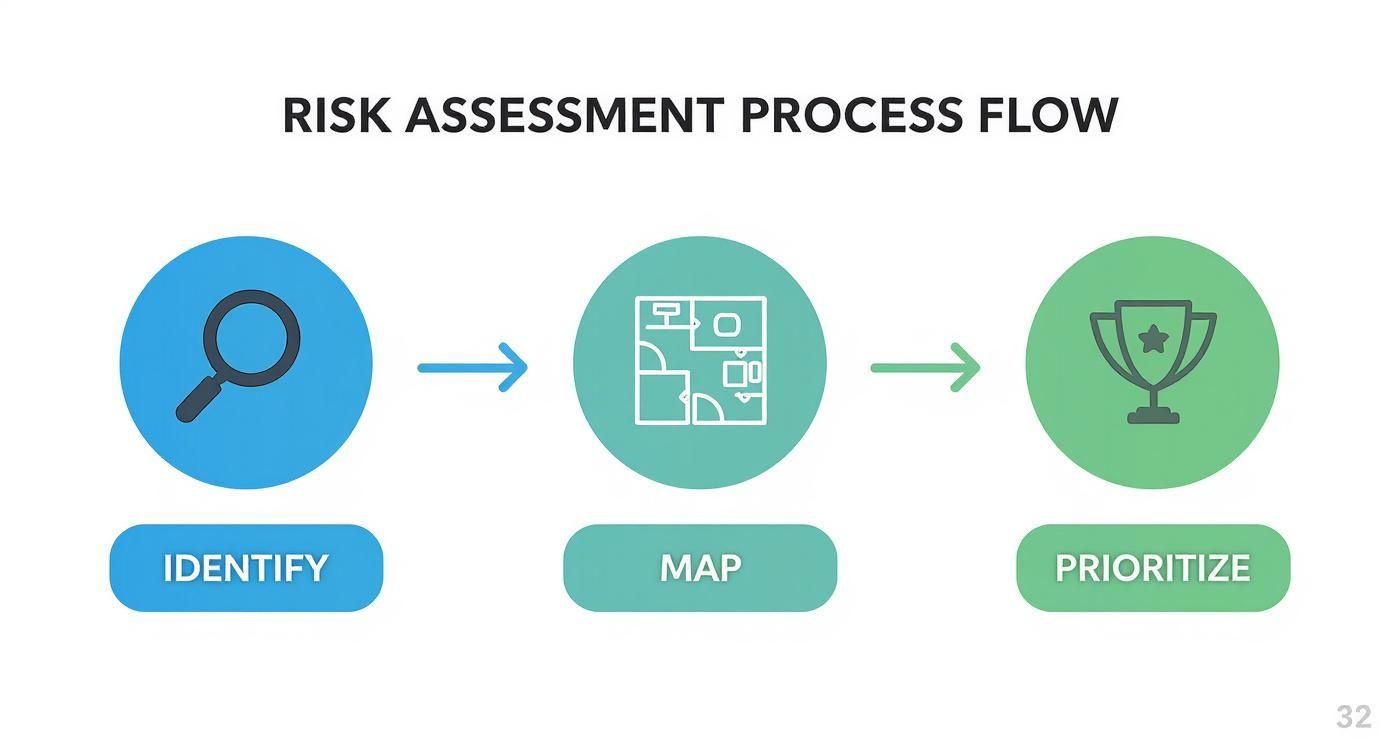
By following these steps, you can turn a potentially chaotic layout into a logical system where contamination risks are designed right out of the picture.
Making the Workflow Flow
Once your zones are mapped out, you need to think about workflow. How do people and things actually move through your space? The goal is a logical, one-way path that prevents anyone from backtracking from a dirty area into a clean one.
Imagine a chef prepping raw chicken. They shouldn't have to walk back through the clean salad prep area just to get to the bin. That’s a recipe for disaster.
Instead, the ideal workflow moves in a straight line or a U-shape. Supplies come in one door, move through storage, raw prep, cooking, and finally to the serving area without ever doubling back. To see how physical barriers and workflow separation are put into practice, it's worth understanding the principles behind well-designed commercial kitchen layouts.
The best systems are the ones that make the safe choice the easy choice. When your workflow is logical, your team doesn't have to think twice about doing the right thing… it just happens naturally.
The Power of Colour Coding
Okay, this is one of my favourite tricks because it's so brilliantly simple, yet unbelievably effective. Colour coding is your secret weapon in the fight against cross-contamination.
It takes all the guesswork out of the equation for your team, especially during a busy, high-pressure shift when mistakes are most likely to happen.
Here’s how you can put it into action immediately:
- Chopping Boards: This is the most common and crucial use. For example: Red for raw meat, green for vegetables, blue for seafood, and white for ready-to-eat foods.
- Knives and Utensils: Go a step further and get knives with coloured handles to match your chopping boards. You can do the same for tongs, spatulas, and other utensils.
- Cleaning Equipment: Use different coloured cloths, buckets, and brushes for different areas. You definitely don't want the cloth used to wipe a floor being used on a food prep surface. A common system is red for high-risk areas (like toilets) and green for food prep areas.
It's a visual language that everyone understands instantly. No need to read labels or second-guess what tool to use. It’s right there in front of them, making it almost impossible to make a mistake.
Essential Gear and Cleaning Protocols
All the best intentions in the world won't stop cross-contamination if you don't have the right tools for the job. Your equipment and cleaning schedule are where the rubber meets the road. The practical, hands-on part of your defence. They're simply non-negotiable.
Let's get into the specifics of Personal Protective Equipment (PPE) and cleaning agents. We'll look at when a simple apron will do and when you need to step it up with gloves, hairnets, and even dedicated footwear.
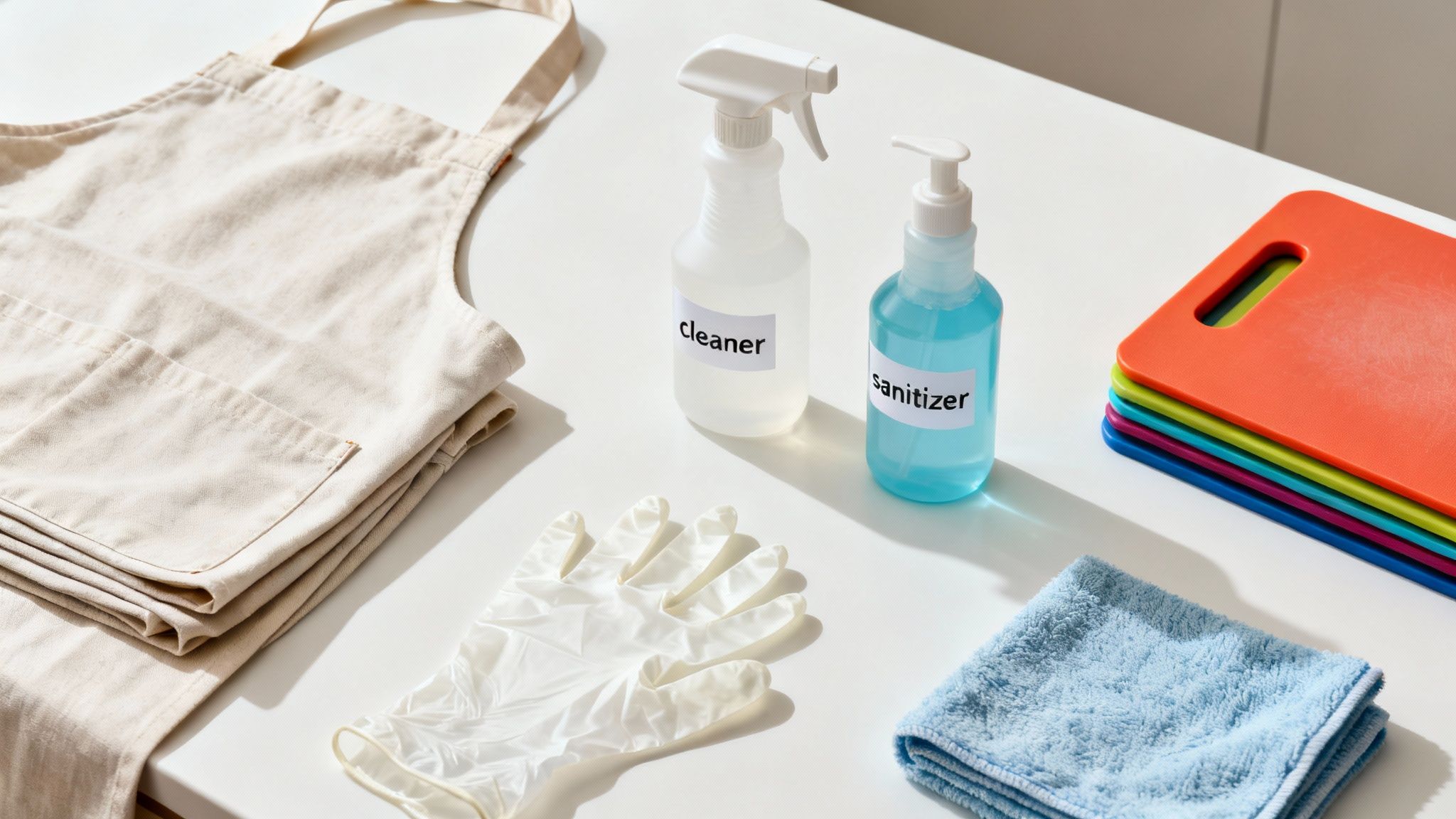
More importantly, we'll cover how to use it all correctly. After all, a dirty glove is no better than a dirty hand.
Gearing Up for Safety
Think of PPE as your team's personal uniform in the battle against bacteria. It’s not about looking the part; it's about creating a physical barrier between a person and a potential contaminant.
It doesn’t need to be complicated. Consistency is what really counts.
- Gloves: Disposable gloves are fantastic, but they come with a huge catch… they must be changed frequently. A team member who handles raw chicken and then moves on to prep a salad without changing gloves is creating a massive contamination risk. They are single-use for a single task.
- Aprons: A clean apron at the start of each shift is a must. If it gets visibly soiled, especially with something high-risk like raw meat juices, it has to be changed immediately.
- Hairnets and Beard Covers: Hair can carry all sorts of bacteria, so keeping it contained is a simple and highly effective control measure.
- Dedicated Footwear: In some high-risk environments, having shoes that are only worn within the workspace is a smart move. It stops contaminants from being tracked in from outside.
The golden rule is this: PPE is a barrier, not a magic shield. It has to be used correctly and changed the second it becomes compromised.
Cleaning vs. Sanitising: The Critical Difference
Now, let's talk about cleaning. I mean really cleaning. A quick wipe-down with a damp cloth just won’t cut it. Proper surface hygiene is a two-step dance, and you absolutely cannot skip a move.
First, you clean. This is the physical act of removing food debris, dirt, and grime from a surface. You're using detergent and a bit of elbow grease to get rid of the visible mess. This step is critical because you can't sanitise a dirty surface. Germs love to hide under bits of food and grease.
Then, you sanitise. This is the chemical step where you kill the germs. After the surface is clean, you apply a food-safe sanitiser to eliminate those invisible pathogens like bacteria and viruses.
It’s a common mistake to mix these up or skip a step, but the consequences can be serious.
Cleaning just moves germs around. Sanitising is what actually kills them. You have to do both, in that order, every single time for a surface to be truly safe.
For instance, recent Australian data on foodborne illness is pretty eye-opening. Between 2015 and 2023, there were 92 outbreaks linked to fresh produce alone, causing thousands of illnesses. The main culprits were Salmonella and Norovirus, often found in mixed meals from commercial settings where a small slip-up in cleaning can have a huge ripple effect.
Let's break down the two processes clearly.
Cleaning vs. Sanitising: What's the Difference?
| Aspect | Cleaning | Sanitising |
|---|---|---|
| Purpose | To remove visible dirt, food, and grease. | To reduce the number of microorganisms to a safe level. |
| Process | Involves scrubbing with detergent and warm water. | Involves applying a chemical or using heat after cleaning. |
| Products | Detergents, degreasers. | Food-safe chemical sanitisers (e.g., quaternary ammonium), hot water. |
Understanding this distinction is fundamental to any effective hygiene protocol. One without the other leaves your business, staff, and customers at risk.
Building a Bulletproof Cleaning Schedule
A cleaning plan that only exists in someone’s head is bound to fail. You need a documented, easy-to-follow schedule that your team can stick to, even on the busiest days.
Start by listing everything that needs attention. I mean everything… from the big equipment down to the light switches and door handles. Then, decide on the frequency.
Here’s a simple way to break it down:
- After Every Use: Cutting boards, knives, prep benches, any surface that touches food.
- Daily: Floors, cooktops, sinks, coffee machines, bin areas.
- Weekly: Fridge and coolroom shelves, ovens, rangehood filters, wall tiles.
- Monthly: Drains, behind heavy equipment, dry storage areas, light fittings.
Putting this into a clear checklist makes everyone accountable. There's no more guesswork; it just becomes part of the routine. If you're looking for a more in-depth guide, our post on professional strategies for cleaning commercial kitchens is a great resource.
Choosing the right chemicals is just as important. Always use food-safe, commercial-grade detergents and sanitisers, and follow the manufacturer's instructions for dilution and contact time. That little detail about letting a sanitiser sit on a surface for a specific time… it’s not a suggestion. It's the time it needs to actually work and kill those germs.
Training Your Team to Spot Contamination Risks
So, you’ve organised your workflow and kitted out your space with all the right gear. But here’s the thing… your systems, zones, and colour-coded boards are only as good as the people who use them every single day. A well-trained team isn't just a nice-to-have. They are your single most important line of defence.
This is all about empowering your staff with real, practical knowledge and building a culture where safety is second nature. When your team understands the 'why' behind the rules, they're so much more likely to follow them, even when things get hectic.
It’s time to forget those boring, one-off training sessions that everyone forgets a week later.
Making Training Stick
Effective training isn't an event; it's an ongoing conversation. People learn best by doing, seeing, and repeating. The goal is to make safe practices feel like muscle memory.
Think about weaving training into the fabric of your daily operations.
- Hands-On Demonstrations: Don't just tell them, show them. A five-minute practical demonstration on the correct two-stage cleaning and sanitising process is worth more than a one-hour lecture.
- Toolbox Talks: Hold short, sharp, five-minute chats before a shift. You could focus on one specific topic each week, like the correct fridge storage order or how to handle allergens safely.
- Visual Aids: Simple, clear posters and signs placed exactly where they're needed can be incredibly powerful. A handwashing guide above every sink. A colour-coding chart on the wall. These are constant, silent reminders.
The aim is to turn every team member into a safety spotter. Someone who can see a potential problem and fix it before it becomes a disaster.
Covering the Absolute Essentials
While training should be ongoing, there are a few non-negotiable topics that everyone needs to master from day one. These are the cornerstones of preventing cross-contamination.
Start with the basics. It’s amazing how many experienced people still get some of this wrong. Proper handwashing technique, for example, is a skill. It involves warm water, soap, and a thorough scrub for at least 20 seconds. That’s the "Happy Birthday" song sung twice, in case you were wondering.
From there, ensure every single person understands:
- The Golden Rule of Storage: Raw meat, poultry, and fish always go on the bottom shelf of the fridge, sealed and contained. No exceptions.
- Safe Waste Handling: Bins need to be emptied regularly, and staff must wash their hands immediately after handling rubbish.
- Reporting Illness: This one is huge. Staff must feel comfortable reporting symptoms like vomiting or diarrhoea without fear of penalty. A sick team member is a massive risk to food safety.
A team that feels empowered and educated is a team that takes ownership. They stop seeing safety rules as a chore and start seeing them as a shared responsibility to protect each other and the customers they serve.
Building a Culture of Safety
Ultimately, you want to create an environment where doing the right thing is easy and automatic. It’s about building a culture, not just enforcing a set of rules. This happens when leaders walk the talk.
When a manager spots a dirty cloth on a prep bench and immediately replaces it, it sends a powerful message. It says, "We take this seriously here."
Encourage questions. Create a space where someone can put their hand up and say, "I'm not sure if this is right," without feeling foolish. That open communication is your early warning system for potential issues. It's how you continuously improve and keep those invisible threats at bay.
Right, you’ve done the hard yards. You've mapped out the workflow, put solid systems in place, and trained your team until they know it backwards. But how do you know it's actually sticking?
You have to check. Simple as that.
Think of it this way: you wouldn't drive your car for years without ever checking the oil or the tyre pressure, would you? Your safety systems are the engine of your business’s entire food safety plan. They need a regular look under the bonnet to make sure everything is ticking along nicely.
This isn't about adding another tedious job to your never-ending to-do list. It’s about building quick, simple checks into your routine so you can spot if standards are starting to slip before it becomes a real problem.
Creating Simple, Effective Checklists
A good monitoring system is all about consistency. And the best way to get that is with straightforward checklists for daily, weekly, and even monthly tasks. These aren’t meant to be intimidating, full-blown audits; they're your early warning system.
Here are a few ideas I've seen work brilliantly:
- Daily Checks (The 5-Minute Scan): These are the absolute non-negotiables you can glance over every single day. They should take no time at all. For example, is the raw meat always stored on the bottom shelf of the fridge? Are the sanitiser spray bottles full and correctly labelled?
- Weekly Checks (The Deeper Dive): Once a week, it's time to take a slightly closer look. This is a great time for a visual inspection of all your chopping boards. Are there any deep scores or cuts where bacteria love to hide? Check the seals on your fridges and freezers to make sure they're clean and intact.
- Monthly Checks (The Big Picture): This one’s for the less frequent but still crucial stuff. Pull out heavy equipment to clean behind it. Check use-by dates in the back of the dry store. This is your chance to catch the things that inevitably get missed in the daily rush.
This proactive approach does more than just keep you compliant. It creates a paper trail that proves you're doing the right thing, and it helps you find small ways to continuously improve your processes over time.
This constant loop of checking, finding small issues, and fixing them is how you make cross-contamination prevention a permanent habit. It shifts safety from a one-off project to a living, breathing part of your business culture. It's about maintaining standards day in and day out, not just reaching them once.
Common Cross Contamination Questions
We get it. Even with the best systems in place, questions always pop up. It’s completely normal, especially when you’re dealing with the nitty-gritty of daily operations.
Here are some of the questions we hear all the time about preventing cross-contamination in a commercial setting. I've put together some straightforward answers to help you navigate these common challenges.
Can I Just Rinse a Cutting Board Between Tasks?
Honestly, no. This is one of the most common… and dangerous… mistakes I see people make. A quick rinse with water might get rid of the visible mess, but it does absolutely nothing to kill the harmful bacteria left behind.
Think of bacteria as being sticky… you need soap and friction to lift them off, then a proper sanitiser to eliminate them. The only safe method is the full two-step process: clean with detergent and hot water, then apply a food-safe sanitiser.
A quick rinse gives you a false sense of security. It leaves behind an invisible minefield of microbes, ready to contaminate the next food item that touches the surface.
What Is The Best Way To Thaw Frozen Meat?
The safest way to thaw frozen meat is slowly, inside the refrigerator. This keeps the meat at a consistently cold temperature, which is crucial for stopping bacteria from multiplying rapidly.
Always, and I mean always, place the thawing meat in a sealed, leak-proof container or on a deep tray. And make sure it’s on the bottom shelf of the fridge. This simple step prevents any raw juices from dripping down and contaminating other foods below. Never, ever thaw meat on the countertop at room temperature… that's just asking for trouble.
For a deeper dive into the fundamental concepts and basic prevention strategies, this comprehensive guide on What Is Cross Contamination and How to Prevent It is an excellent resource.
Keeping your workspace safe is an ongoing commitment, but it doesn't have to be complicated. If you need a hand ensuring your commercial space meets the highest standards of hygiene, That Cleaning Crew provides expert cleaning services to help you protect your staff and customers. Request your free on-site quote today.